
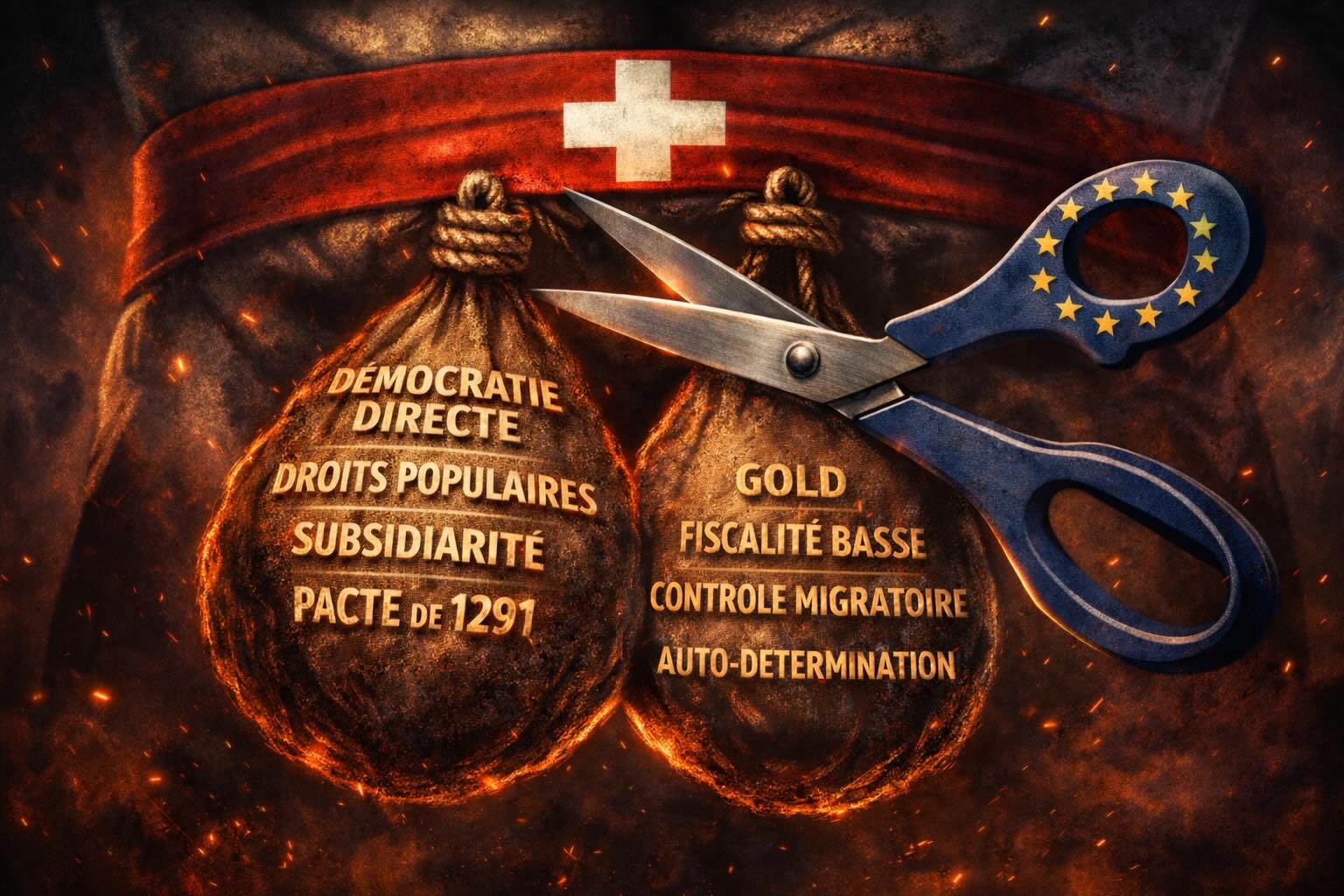
They advance in disguise, speaking of ’adaptation,« »legal certainty,« and »economic necessity.« In reality, a silent shift is being prepared: a transfer of sovereignty, the automatic adoption of foreign law, and the gradual bypassing of the people. Under the influence of powerful lobbies, our direct democracy is being hollowed out, not by frontal assault, but by a slow technocratic erosion. What's at stake isn't just another agreement – it's the ability of the Swiss people to still decide for themselves and to preserve their treasured heritage at all costs.
In Switzerland, there is a red line that no one has ever dared to cross head-on: that of popular sovereignty. Today, this line is being circumvented — methodically, silently, legally — by those who claim to speak in the name of “the economy”.
Because behind the technocratic discourse on “stability”, “predictability” or “competitiveness”, a reality is emerging: a coordinated offensive by major economic lobbies to profoundly transform our political system.
The facts are there.
Economiesuisse represents over 100,000 businesses and 2 million jobs in Switzerland, and explicitly acts as an influential player in the political process. .
Swissmem does not even hide it: it “selectively puts forward the interests of companies in the political process”, participates in legislative procedures, and conducts voting campaigns. .
The Federation of Romande Businesses The (FER), particularly active, is no longer content to defend economic interests: it is now distinguished by a targeted communication that blurs public debate and fuels genuine disinformation on institutional issues.
As for Avenir Suisse, funded by major multinational corporations, it produces the intellectual doctrine that legitimises this structural transformation. .
And the money followed: in 2024, economic lobbies dominated the voting campaigns, with several million francs invested — 5.7 million of which was for Economiesuisse alone. .
But the heart of the problem doesn't lie there.
The real danger is the project.
A project for gradual alignment with the European Union, through mechanisms for the automatic adoption of foreign law.
A project that hollows out direct democracy, transferring fundamental decisions beyond popular control.
A project that replaces political sovereignty with legal compliance.
It's not an adaptation.
It's a mutation.
Switzerland is based on a unique architecture:
popular initiative, referendum, constitutional sovereignty.
However, this architecture is now being circumvented by a new method: legal technocracy.
Popular rights are not removed.
We render them inoperable.
Through binding international agreements.
By external arbitrage mechanisms.
By standards automatically taken over, without a vote, without debate, without a real possibility of refusal.
As recalled Transparency International Switzerland, lobbying is only legitimate if it remains transparent – otherwise, it can devolve into forms of undue influence that are contrary to democracy. .
Are we still in transparency?
Or already in the capture?
What is at stake here goes far beyond the agreements themselves.
It's a clash of models.
On the one hand:
Switzerland founded on individual responsibility, popular decision-making, and sovereignty.
On the other hand:
a governance driven by organised economic interests, supported by external normative production, and validated by technocratic elites.
And what about this fundamental contradiction:
99 % of Swiss companies are SMEs. .
But structural decisions are driven by organisations that primarily represent large corporations, multinationals and exporting sectors.
In other words: a structured minority speaks on behalf of a silent majority.
The truth is simple.
What some call “modernisation” is actually dispossession.
What they call “integration” is dilution.
What they present as an “economic necessity” is an ideological preference.
A lazy innovation: importing rules rather than building Swiss solutions.
Switzerland is not a subsidiary.
This is not a regulatory platform.
This is not a territory to be optimised.
It is a political nation.
And a nation that renounces the right to decide for itself ceases to be a nation.
Conclusion
Economic lobbies can weigh in, fund, and influence.
They can even win votes.
But they must never write on behalf of the people.
Because the day Switzerland abandons its direct democracy in the name of “economic rationality”, it does not become more efficient.
She's becoming replaceable.