What if the real disinformation wasn't where it's being denounced? By attacking the 10 million inhabitants initiative, Alexandre de Senarclens claims to set the record straight – but his argumentation relies on a series of shortcuts, approximations, and carefully cultivated fears. Behind the slogans, a reality emerges: the debate deserves better than caricatures.
In an opinion piece published in the Tribune de Genève on 25 March 2026, Alexandre de Senarclens, a PLR [Liberal Party] MP and Genevan president of the European Movement, claims to denounce the «disinformation» surrounding the initiative on the 10 million inhabitants. Ironically, it is precisely his line of argument that relies on a succession of shortcuts, approximations, and ideological postulates. Point-by-point deconstruction.
1. The myth of the «arbitrary ceiling»
De Senarclens states:
«She plans to arbitrarily and rigidly set a cap on the number of residents.»
It's a caricature. The initiative does not set a fixed cap, but a trigger threshold (10 million) from which Switzerland regains control of its immigration policy.
Talking about arbitrariness means denying a simple reality: all public policy rests on thresholds (budgetary, environmental, demographic). To refuse this principle is to refuse all regulation.
2. The automatic termination of free movement: a fiction
«Switzerland should de facto terminate the free movement agreement»
False. The text explicitly provides for a progressive action phase:
- From 9.5 million: targeted measures (asylum, family reunification)
- Then: Attempt to renegotiate with the EU
This is far from an automatic mechanism. The discourse of brutal rupture serves here to frighten, not to inform.
3. The «guillotine clause» scaremongering»
«This would cause all bilateral agreements to fall.»
Major confusion. The guillotine clause only applies to bilateral agreements I, pause:
- Schengen
- Dublin
- nor the bilateral agreements II
To compare the entirety of Swiss-EU relations to a fragile domino strikes me as more of a slogan than a legal analysis.
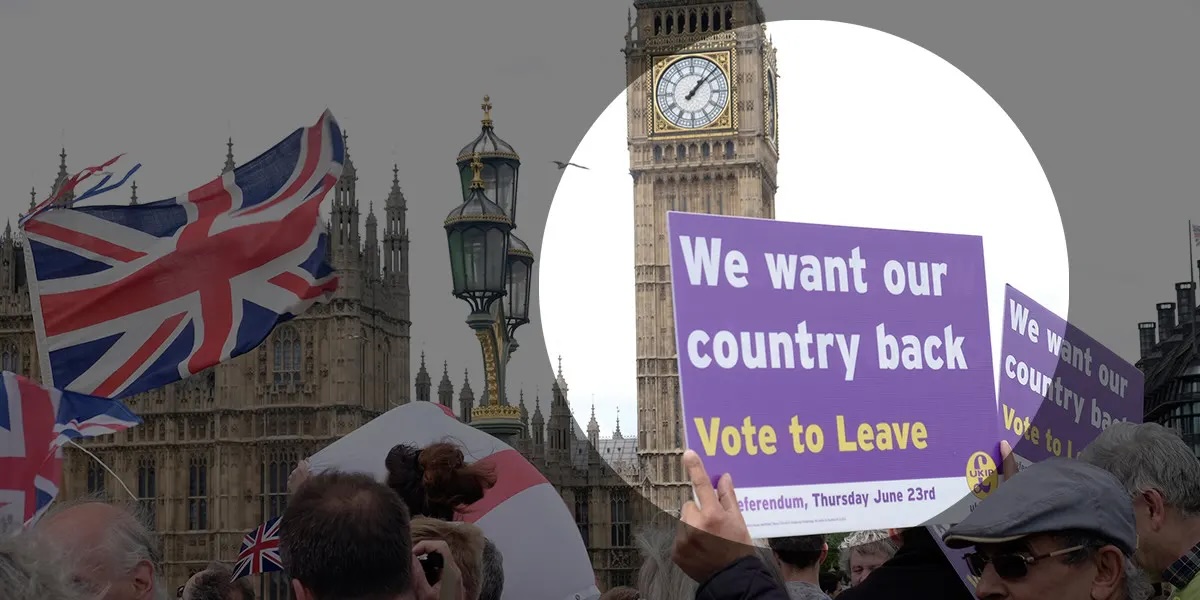
4. The cliché of the «isolated» United Kingdom»
«The United Kingdom has decided to isolate itself»
Emotional formula, but empty of content. What does «to isolate oneself» mean in a globalised world?
The United Kingdom remains:
- one of the most open economies on the continent
- A major player in global trade
With Switzerland, it is among the countries least dependent on the EU. Talking about isolation is therefore misleading.
5. The magic figure of «-6 to -8% of GDP»
«Brexit has caused a loss of 6 to 8% of GDP»
Compared to what? A hypothetical scenario.
This type of estimation is based on Unverifiable counterfactual models. A real-world observation is compared to a theoretical projection.
In other words: a disguised opinion presented as a figure.
6. British Growth: A Wilful Blind Spot
De Senarclens evokes «weak growth». However, the data shows that since 2021:
- The United Kingdom has often done better than Germany
- comparable performance to France
- sometimes better than the Eurozone
Ignoring these elements is selecting facts to support a narrative.
7. «High quality» immigration? An implicit bias
Non-EU immigration = «grim outcome»
Problematic underlying meaning: non-European workers would be less desirable.
However, a serious migration policy is not based on geographical origin, but on:
- skills
- economic needs
- integration
This shift reveals a contradiction in the pro-European discourse.
8. The trial of the people for irrationality
«The initiative would close the door without considering the needs.»
This statement is based on an implicit idea: the people would vote against their own interests.
That's to misunderstand how Switzerland works:
- pluralistic information
- regular votes
- High political culture
Questioning the citizens' ability to discriminate is, in fact, to undermine democracy itself.
Conclusion – The Real Debate: Sovereignty or Caricature
Alexandre de Senarclens« editorial claims to debunk »clichés". Yet, it accumulates an impressive number of them: arbitrary ceiling, British isolation, economic collapse, threatened agreements...
Behind these approximations, one constant: avoiding the heart of the matter.
Because the real question isn't technical. It's political:
Should Switzerland retain control over its demographics and sovereignty?
Or accept that they are defined elsewhere?
By replacing debate with fear and simplification, some hope to discredit an initiative without discussing it.
But in direct democracy, one thing remains:
It is not for editorialists to decide.
It's up to the people.