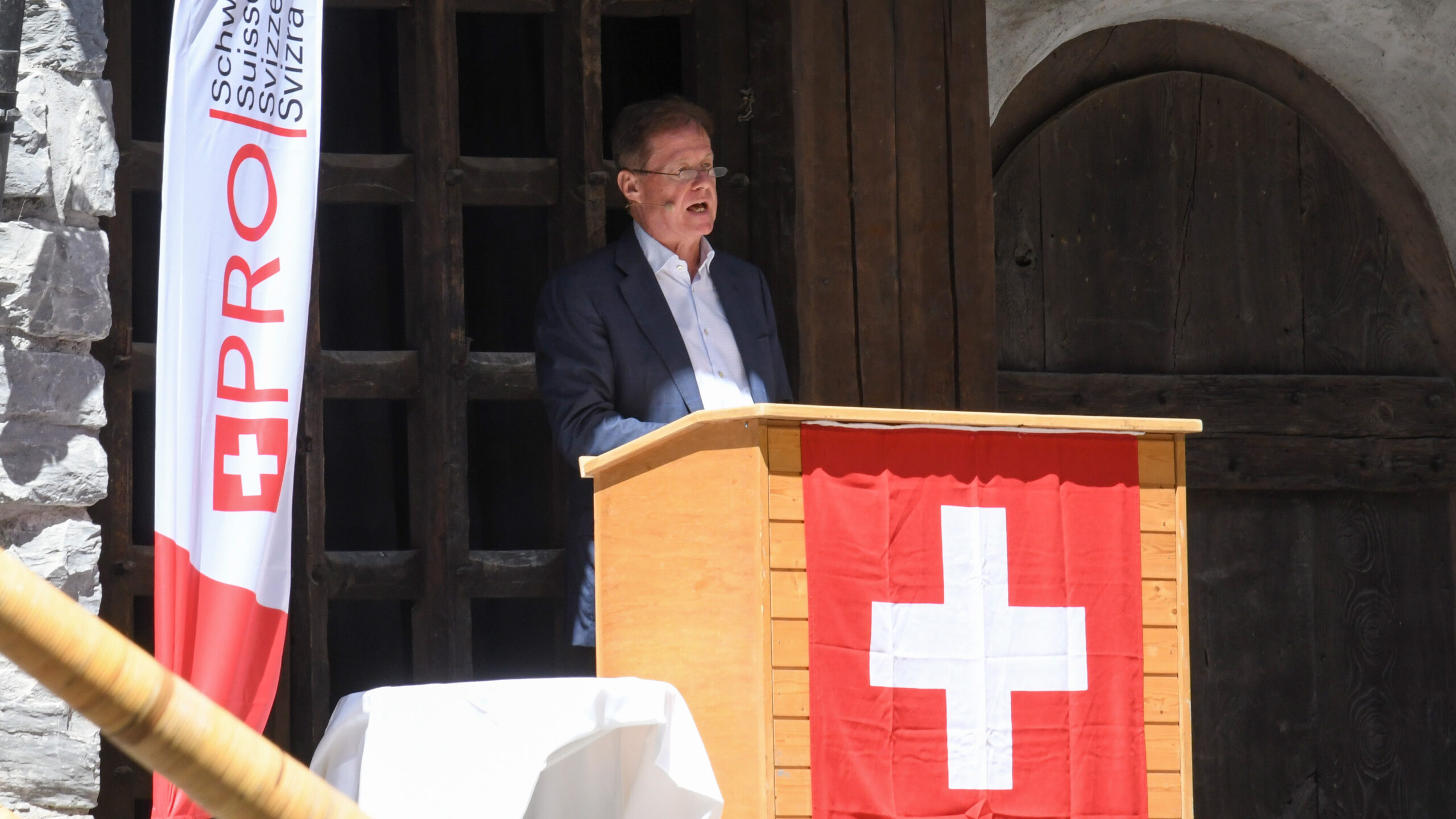
Between unkept promises and explosive reality, the migration issue presents itself as the breaking point for the Swiss model. In this interview, Pro Suisse gives voice to a widely felt unease: loss of control, pressure on infrastructure, and institutional drift. The «No to 10 Million Swiss» initiative on June 14th could well be the first nail in the coffin of the EU agreement for submission, which is nothing more than gradual accession through law and standards.
Source : Interview with Stephan Rietiker in 24 Hours
A finding that has become undeniable: uncontrolled migratory pressure
Stephan Rietiker's analysis is based on a fact that more and more Swiss people are experiencing concretely: Rapid population growth puts direct pressure on the country.
Since 2000, Switzerland has gained nearly 2 million inhabitants, an unprecedented evolution. But above all, a key element must be remembered:
During debates on free movement, the Federal Council spoke of controlled flows of around 8,000 net entries per year.
⮕ The observed reality is quite different: around 75,000 net annual entries in recent years.
This massive discrepancy is not a mere forecasting error:
it's a major political breakdown of trust.
Concrete consequences:
- Rent explosion
- Infrastructure saturation
- increased pressure on wages and public services
«Chaos» used by Rietiker corresponds to a lived reality.
Regaining control: a selective and sovereign immigration policy
The proposal is clear:
«To welcome only those people we truly need.»
With a budget of around 40,000 annual entries, Switzerland could:
- find a control of its growth
- target high-calibre profiles
- reduce structural pressure
It's not about closing Switzerland off, but about to put an end to uncontrolled and imposed immigration.
The current free movement precisely prevents this steering.
Cross-border workers: a pragmatic solution
Rietiker highlights an often overlooked point:
«Cross-border workers are a lesser evil»
Indeed, cross-border workers:
- they do not saturate the housing
- use social services less
- contributing to the economy without settling permanently
With about 380,000 cross-border workers, Switzerland already has a flexibility tool.
This distinction allows to To preserve the economy without worsening internal demographic pressure.
Agreements with the EU: a drift towards loss of sovereignty
Rietiker rightly denounces the “Bilaterals III”:
«A blatant lie»
These agreements involve:
- dynamic take-up of European law
- Increased role of the Court of Justice of the European Union
- weakening of the people's power
⮕ We're moving from balanced agreements to a Progressive integration without membership voting.
The initiative thus constitutes a essential democratic stopping point.
The EU: a partner, but not a model
Rietiker calls into question the idea of automatic alignment:
- German economic stagnation
- energy instability
- growing bureaucracy
The more one aligns oneself with this system, the greater the risk of’to import one's fragilities.
Neutrality: a strategic strength
«Neutrality does not equal cowardice»
Swiss neutrality:
- strengthen international credibility
- facilitates global economic relations
- protect the country from bloc logic
Diluting it would amount to weakening a historic pillar of Swiss prosperity.
A coherent vision: sovereignty, stability, prosperity
The Pro Suisse project is structured around four axes:
- democratic control of immigration
- Infrastructure protection
- Legal independence
- declared neutrality
The «No to 10 Million Swiss» initiative becomes a global strategic tool.
Conclusion
The interview with Stephan Rietiker in 24 Hours highlights a fundamental reality:
The initial promises on immigration have not been met..
Between the 8,000 entries announced and the 75,000 observed, the gap is such that it justifies a complete overhaul of the system.
Taking back control is no longer an ideological option, but a political necessity to restore Switzerland's trust, stability, and sovereignty.