
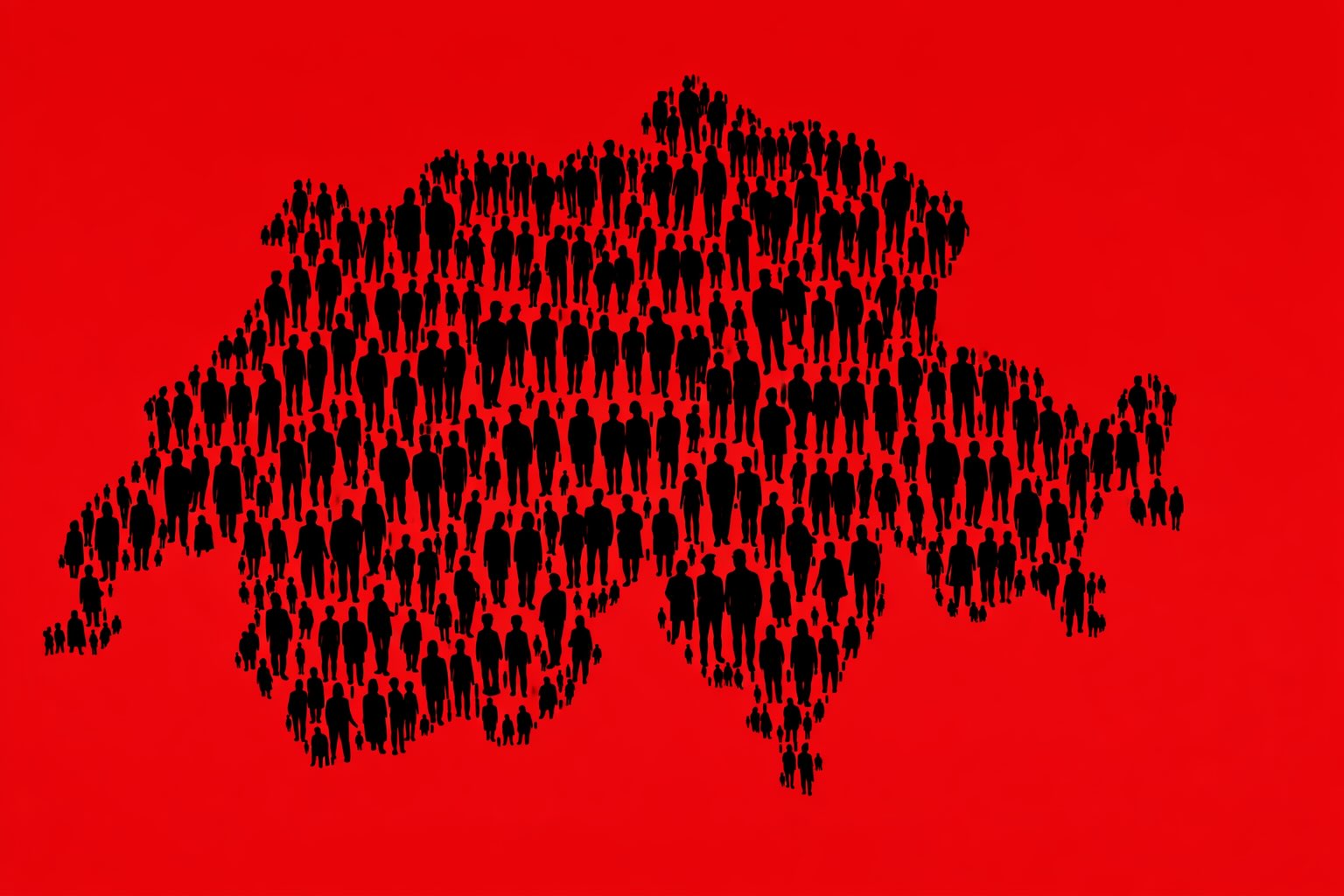
What if Switzerland's rapid demographic transformation was not just an economic consequence, but also a political choice? In the space of twenty years, our country's population has grown from around 7 million to over 9 million, with visible effects on wages, housing and public finances. In the run-up to the vote on 14 June 2026 on the «No Switzerland with 10 million inhabitants» initiative, one question deserves to be asked without taboo: who is really benefiting from this accelerated demographic growth?
In Switzerland, some debates have become almost impossible.
These include: the link between immigration, the welfare state and political calculation.
Officially, the free movement of persons is merely an economic instrument designed to meet the needs of the labour market.
In reality, the effects are much broader.
Since 2000, the Swiss population has grown from around 7.2 million to over 9 million inhabitants. Much of this growth is due to immigration linked to free movement.
This rapid demographic transformation is profoundly changing the economy, the labour market and the social system.
Structural pressure on income
In many sectors, the massive influx of labour has contributed to keeping wages under pressure, At a time when the cost of living is skyrocketing.
Housing, energy, health insurance premiums: everything is rising faster than incomes.
The result is visible in public finances.
The example of Geneva
In the canton of Geneva, health insurance subsidies have risen sharply in recent years.
Today, aid is often deducted directly from premiums, No administrative formalities are required.
This mechanism reveals a simple economic reality:
⮕ a growing proportion of households can no longer pay its basic expenses without public assistance.
In other words, the State is increasingly compensating the effects of a tight labour market.
A low-wage business model?
In some urban areas, the proliferation of small independent businesses and micro-businesses is also evidence of an economic transformation.
Many operate on extremely low margins, sometimes in very tough competitive conditions.
This phenomenon raises a central question:
⮕ Is Switzerland moving towards a growth model based on permanent population growth rather than productivity and wages?
Immigration and political strategy
In this context, one element is rarely discussed openly:
immigration is also changing political and electoral balance of the country in the long term.
The faster the population grows, the more the social structure changes:
income, dependence on public support, composition of urban areas.
These transformations have inevitably political consequences.
For some globalist parties, mainly on the left (Socialist Party, Greens), supporting high levels of immigration may therefore appear to be consistent with their economic and social vision: a greater State presence, more redistribution and increased public intervention.
But above all, it's also a way of create a new captive electorate, called on to vote for them, to the detriment of ethnic voters. That's the logic, economic immigration and family reunification play a central role, insofar as this immigration is often unskilled and mostly supports left-wing parties.
The vote on 14 June 2026
This is precisely the context in which the Swiss will vote on the initiative «No 10-million Switzerland».
Beyond the slogan, the question posed is fundamental:
⮕ Does Switzerland want to continue on a trajectory of rapid demographic growth, or does it want to regain more control over its development?
Conclusion
For a long time, Switzerland had a simple model:
- a productive economy
- high salaries
- a strong but sustainable welfare state
- and controlled demographic growth.
The question today is clear:
Can this model survive such rapid demographic growth?
On 14 June 2026, this debate can no longer be avoided.
And as always in Switzerland, the decision will rest with the people.