
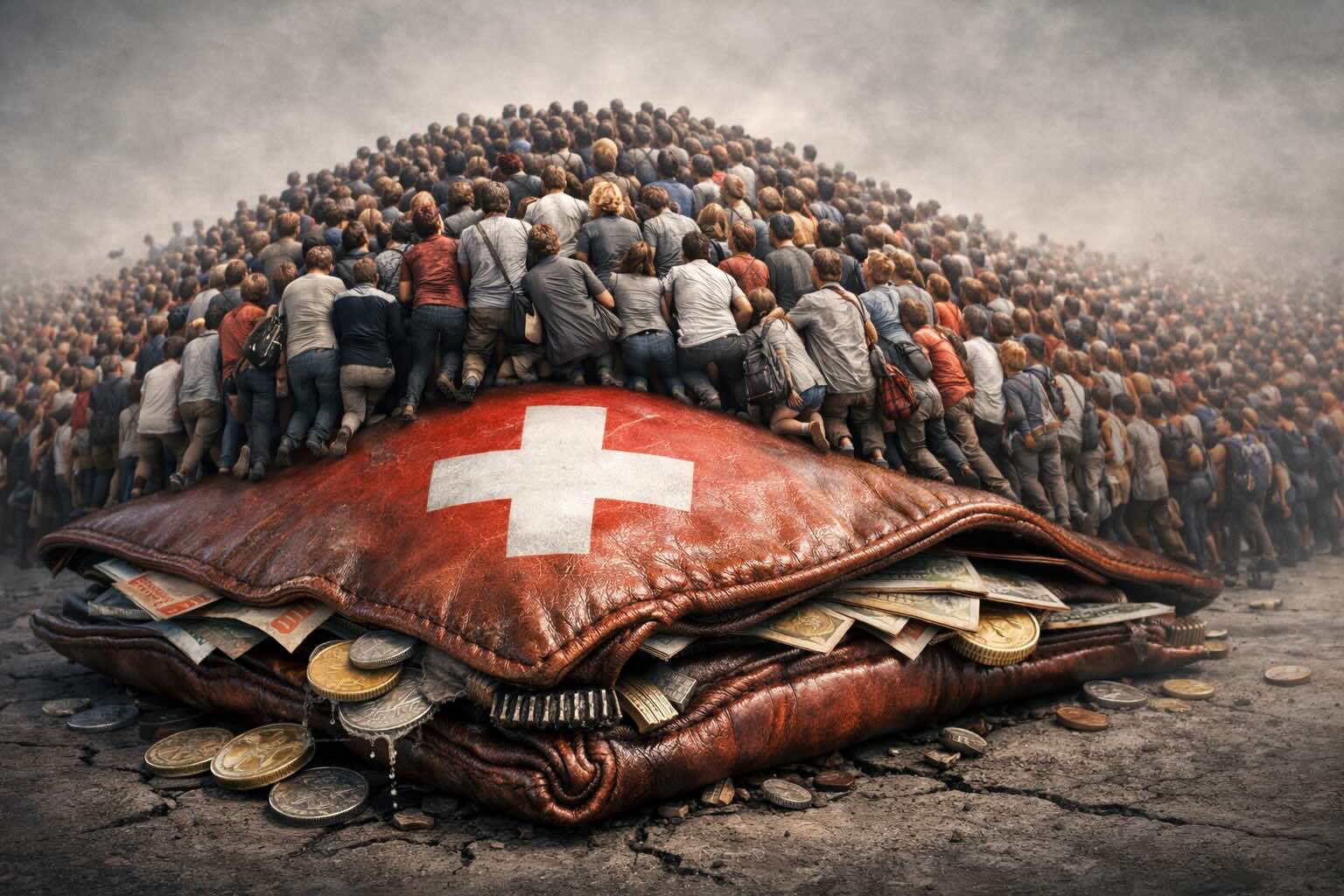
What if mass immigration also had a hidden tax bill?
For twenty years, the debate on free movement has focused almost exclusively on the needs of the economy. But there is a much more concrete reality that directly affects the middle class: the faster the population grows, the more the state has to spend - and the more taxpayers have to pay. Schools, roads, transport, administration, social benefits: massive demographic growth mechanically leads to an expansion of the State and an increasing tax burden. A mechanism that is rarely discussed, but whose effects are already being felt in the wallets of Swiss households.
For years, the debate on free movement has focused almost exclusively on the needs of the economy and the labour market. But one central aspect remains largely absent from the public debate: the real fiscal cost of the rapid demographic growth that these agreements have brought about.
A rapidly growing population is never economically neutral. It requires more infrastructure, more schools, more transport, more administration and more public services. And this expenditure must be financed.
So the issue is not just migration or the economy: it is budgetary and fiscal.
Historic demographic growth
Since the entry into force of the free movement of persons with the European Union in the early 2000s, Switzerland has experienced one of the fastest demographic growth rates in Europe.
A few figures speak for themselves:
- The Swiss population has grown from around 7.2 million in 2002 to over 9 million today.
- This represents almost 2 million additional inhabitants in two decades.
- Most of this growth came from net immigration linked to free movement.
In practice, this dynamic is equivalent to adding a city the size of Zurich every four to five years.
But each new inhabitant automatically implies collective costs.
Infrastructure in constant need of rebuilding
A rapidly expanding population is forcing the state to invest massively in infrastructure.
In practical terms, this means :
- construction of new schools
- extension of public transport
- expansion of roads and motorways
- development of hospitals
- multiplication of administrative services
These investments are far from marginal.
The Confederation believes, for example, that the rail programme PRODES 2035 represents more than 12 billion francs of investment.
Le Fund for national roads and agglomeration traffic (FORTA) is mobilising several billion a year to adapt the road network to traffic growth.
At the same time, the cantons must finance :
- new primary and secondary schools
- the extension of urban transport networks
- from additional hospital zones
- an increase in administrative staff.
In other words, demographic growth is forcing the state to constantly rebuild the country.
A silent explosion in public spending
This dynamic is clearly reflected in public finances.
Consolidated public spending in Switzerland has risen from around :
- 160 billion francs in the early 2000s
- à 250 billion today.
Of course, there are a number of factors behind this rise. But rapid demographic growth is one of the structural drivers.
More inhabitants automatically means :
- more pupils in schools
- more transport users
- more claims for social benefits
- more public employees.
Even when tax revenues are rising thanks to economic activity, expenditure often follows even faster.
The middle class picks up the bill
The problem is that these additional costs are mainly financed by taxpayers already established, The vast majority of them are middle class.
They are the ones who put up with it:
- income tax
- wealth tax
- VAT
- local and cantonal taxes
- infrastructure costs.
In many regions, this tax pressure is accompanied by another phenomenon: the explosion in housing prices.
Between 2000 and today, property prices have risen by more than 80 % in some regions, This is largely due to demographic pressure.
Result:
- higher rents
- purchase price out of reach for many households
- rising fixed costs.
The middle class is therefore faced with a double economic shock: fiscal and property.
A political taboo
Despite these realities, the link between mass immigration, public spending and tax pressure is rarely tackled head-on.
The debate is often presented solely in terms of economic growth or the need for labour.
But demographic growth also has a considerable collective cost.
Ignoring this dimension means gradually transferring the bill to taxpayers, without any real democratic debate on its consequences.
Conclusion
Free movement has profoundly transformed Switzerland's demography.
But behind all the talk of growth and openness lies a reality that is much less discussed: the growing tax and property burden on the middle class.
Every million additional inhabitants means billions in public investment, new taxes and infrastructure to rebuild.
So the issue is no longer just one of migration.
It's simple:
How much population growth can Switzerland absorb without sacrificing the purchasing power and fiscal stability of its middle class?