
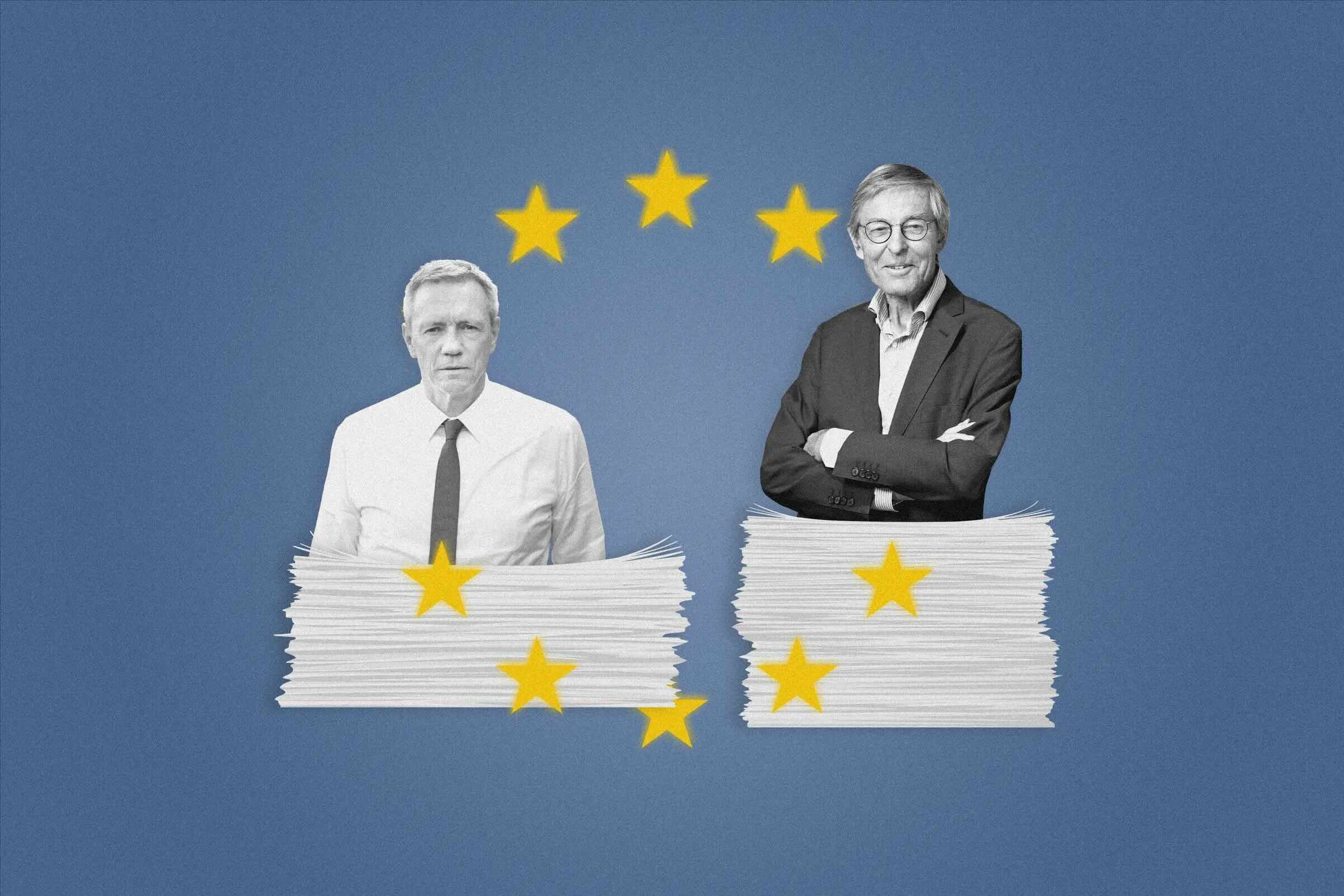
What if the issue was no longer economic, but institutional?
In an interview published in the NZZ, former federal lawyer Paul Richli issues a warning that has rarely been expressed so clearly: the adoption of European law and the new institutional agreements with the EU could profoundly transform Switzerland's political functioning - to the point of making it virtually impossible to turn back the clock. This debate is essential if we are to understand what is really at stake behind these treaties.
The debate on the future institutional agreements between Switzerland and the European Union regularly rears its head in the public arena. Presented by their supporters as a simple «stabilisation mechanism» for bilateral relations, these treaties would in fact entail a profound change in the legal and political structure of the Confederation.
A recent debate published by the Neue Zürcher Zeitung (NZZ) of 27 February 2026 highlights the scale of these issues. Two legal experts compare their analyses: Martin Dumermuth, a former senior official in the Federal Department of Justice who was in favour of the agreements, and Paul Richli, former Rector of the University of Lucerne and a specialist in public law, who is firmly opposed to the idea.
Paul Richli's warnings deserve particular attention. They accurately describe the institutional consequences of such a system.
A major transfer of legal power
According to Paul Richli, the adoption of a’dynamic alignment with European law would constitute a fundamental break in the Swiss constitutional order.
As he explains:
«Adopting European law would have enormous consequences. The Federal Council is playing down the consequences.»
The central problem lies in the very logic of the system. European standards are constantly evolving. A dynamic alignment mechanism would mean that Switzerland would have to adapt its domestic law to these developments, often without direct participation in the decision-making process.
Richli stresses that this development would profoundly transform the way the Swiss political system works:
«Parliament would abdicate its role. There would be no more consultation process. The business community would lose all means of influencing Parliament; it would have to lobby Brussels directly.»
In other words, a large part of the normative production would no longer go through the traditional Swiss institutions - consultation, parliamentary debates and, ultimately, direct democracy.
The illusion of Swiss influence in Brussels
Some supporters of the agreements maintain that Switzerland could still exert an informal influence on European legislation.
For Richli, this idea is largely an illusion.
He draws particular attention to the example of the’European Economic Area (EEA) :
«The example of the EEA Member States, which have virtually no decision-making powers, demonstrates this.»
These countries have to adopt a large part of European law without really participating in its design. Switzerland would run the risk of finding itself in a similar situation: applying standards decided elsewhere.
The «compensatory measures» mechanism»
Another particularly sensitive issue concerns compensatory measures that the European Union could impose in the event of divergence.
Richli describes a legally asymmetrical system:
«The EU could impose offsets in any area, even unrelated ones, such as medical or food products.»
This logic creates permanent uncertainty:
«Switzerland does not know where the EU will intervene. No one wants to take the risk of being affected by an unknown compensatory measure.»
Under such a system, political and economic pressure would provide a strong incentive for Switzerland to accept the requested adjustments, even in the event of disagreement.
The uncertain role of the arbitral tribunal
The draft agreements provide for a dispute settlement mechanism based on an arbitration tribunal.
But Richli wonders how it really works:
«How is the arbitral tribunal supposed to determine whether extrajudicial measures are proportionate?»
It also highlights the decisive importance of the personalities appointed:
«A lot will depend on who is elected to the arbitration tribunal and whether they can truly represent our interests.»
As a warning, he refers to the experience of the Swiss judge at the European Court of Human Rights, which has sometimes voted against the Swiss position.
Growing pressure to integrate
Richli also believes that these agreements would not constitute lasting stabilisation, but rather a step towards gradual integration.
He states:
«It is likely that the EU will soon exert additional pressure on Switzerland to adopt dynamic legislation in other areas, such as the free trade agreement.»
In his view, Brussels' strategic objective is clear: to avoid having to renegotiate regularly with Switzerland and gradually integrate its legal framework into that of the EU.
The example of current trade tensions
Richli also points out that economic tensions already exist, despite the current agreements.
In particular, he cites European pressure on certain industrial sectors:
«We are currently seeing how the EU wants to impose customs duties on Swiss steel specialities. This is a flagrant violation of the free trade agreement.»
In other words, even within the current framework, relations are still marked by recurring trade conflicts.
The decisive point: irreversibility
But Richli's central warning concerns the irreversible dimension of these agreements.
It sums up this reality in no uncertain terms:
«We need to be aware of this: if we conclude these agreements, it will be virtually impossible to turn back the clock.»
In a system where a large part of the law would be progressively aligned with that of the European Union, an exit would become politically and legally extremely complex.
Conclusion - The fundamental question: who decides in Switzerland?
Basically, the debate goes far beyond the simple technical management of relations with the European Union.
The central question is institutional: Who decides which law applies in Switzerland?
The Swiss model has been based on a particular balance for centuries:
Confederation, cantons, economic consultation, direct democracy and parliamentary accountability.
If an increasing proportion of legislation comes from an external legal order, this balance changes mechanically.
As Paul Richli sums up in the interview published by the NZZ (27 February 2026) :
«We are naive to believe that we would not lose significant powers.»
In other words, behind the diplomatic language of «institutional agreements» lies a much more fundamental issue: Switzerland's ability to remain master of its own law.