
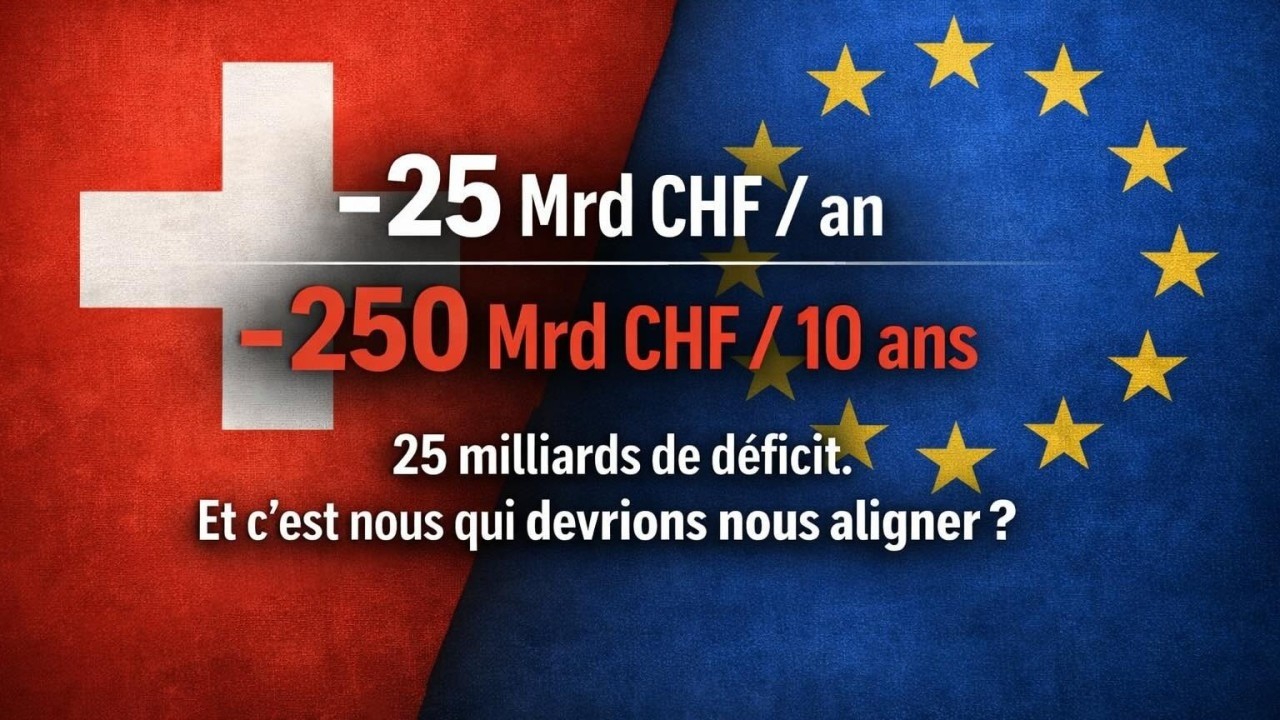
We are being asked to give up our legal sovereignty for... non-existent economic gain.
Under the reassuring label of ’bilateral agreements«, the EU is proposing that Switzerland unilaterally align itself with its standards, even though we have an annual trade deficit of 25 billion with Brussels. In other words: we are customers - yet we are being asked to submit. Worse still, even the supporters of the agreement admit that the economic impact would be marginal, almost non-existent. So the question is: why give up so much for so little?
It continues to be called «bilateral agreements».
It's a political lie.
The EU-Switzerland framework agreement is neither bilateral, balanced nor mutually beneficial.
It is a agreement to adhere to standards, A progressive legal submission, disguised as technical cooperation to better disarm democratic debate.
Behind the reassuring words - stability, legal certainty, market access - hides a cold reality: Switzerland gives a lot, but gets nothing.
1. A truth no one wants to look at: Switzerland is an EU customer
The figures are indisputable.
⮕ Annual trade deficit with the EU: ~CHF 25 billion
⮕ Over ten years: ~CHF 250 billion transferred to Brussels
This means one simple thing: the European Union has a vital interest in selling to Switzerland.
We are a solvent, stable, open market - not the other way round.
In any rational negotiation, the customer has leverage.
Here, Switzerland is behaving like a begging country, ready to concede its legal autonomy in order to retain access... for which it is already paying dearly.
2. The export mirage: even supporters admit insignificance
Even supporters of the agreement recognise the weakness of the economic argument.
According to savingsuisse, The framework agreement would increase Swiss exports to the EU by :
⮕ CHF 500 million per year
In relation to our current exports to the EU, this represents :
⮕ approximately +0.3%
In other words: statistically negligible.
Macroeconomic background noise, used as a pretext to justify a major structural transformation of our legal system.
Cede the sovereignty of the law to 0.3% of hypothetical exports is not pragmatism.
This is a failure of governance.
3. Nothing bilateral: one aligns, the other decides
The framework agreement establishes :
- l’dynamic alignment on European law
- l’ultimate interpretation entrusted to the Court of Justice of the EU
- from automatic penalties in the event of a Swiss discrepancy
The EU retains its sovereign right to legislate.
Switzerland is becoming standard-taker, without the right of co-decision.
To call this «bilateral» is semantic manipulation.
«When only one party writes the rules, it's not a partnership. It's subordination.»
4. No economic benefits, but a massive political cost
What the framework agreement does not :
- no significant new access to the market
- no export boom
- no protection for SMEs
- no measurable economic security
What he imposes :
- a lasting transfer of sovereignty
- democratic insecurity (the law is no longer decided in our country)
- irreversible structural dependence
Economically useless.
Politically dangerous.
Conclusion: this is not an agreement, it's a renunciation
A country with 250 billion trade deficit over ten years has no reason to kneel.
A prosperous country does not exchange its legal autonomy for 0.3% of fantasy exports.
A sovereign country does not delegate its rights to buy regulatory peace.
The EU-Switzerland framework agreement is not an economic necessity.
It is a ideological choice, contrary to the country's material interests.
Switzerland does not need to fall into line.
It needs respect each other.
🇨🇭 Without funding, there can be no resistance. Support Swiss Sovereignty now: https://souverainete-suisse.ch/faire-un-don/
We analyse what the media keep quiet. What Berne negotiates, we dissect. Join our HQ on Telegram now: https://t.me/swisssovereignty