
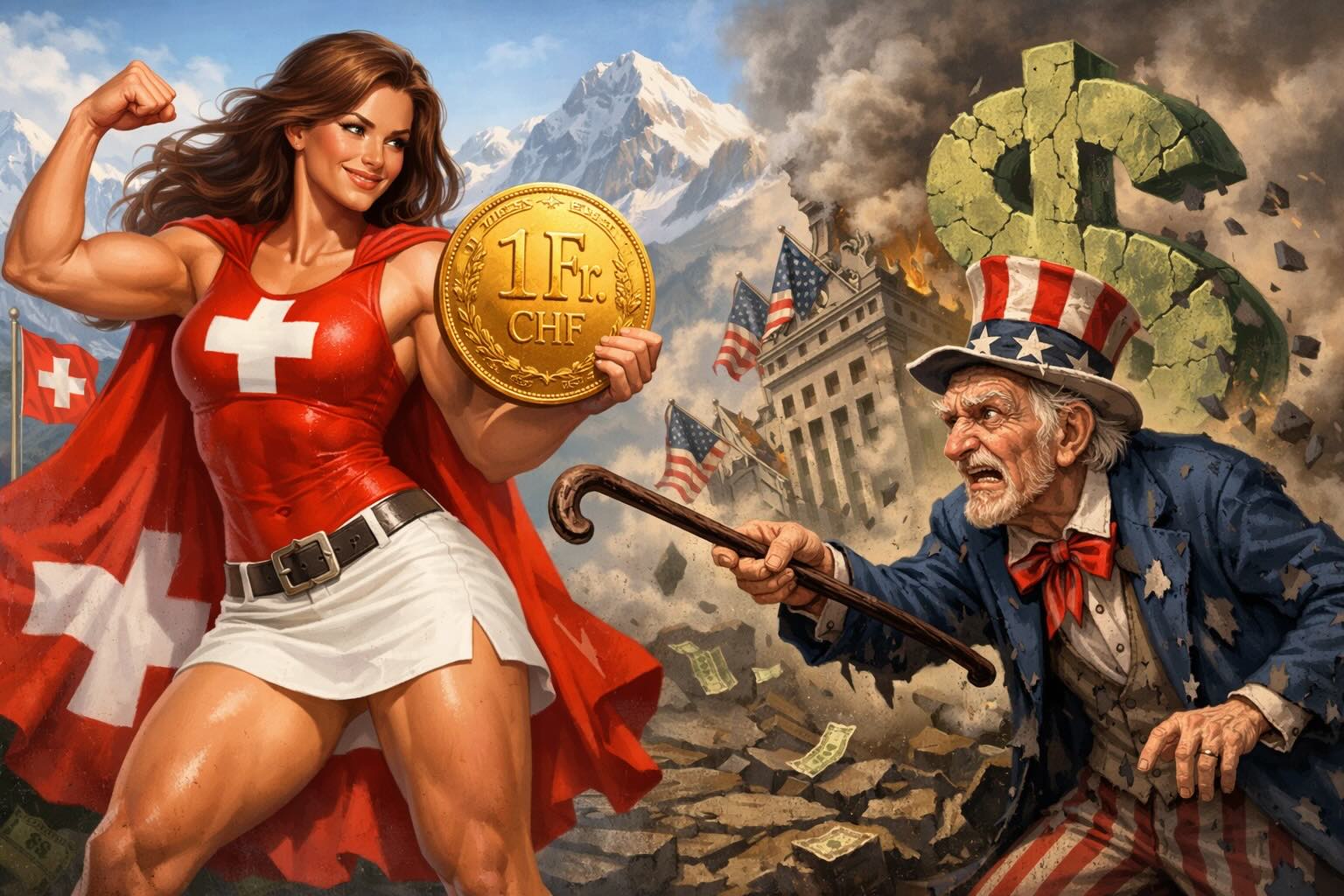
While Washington is playing poker with the global economy, the rest of the world is beginning to look at its cards. Tariffs declared illegal by the Supreme Court, growing military tensions in the Middle East, colossal debt financed by printing money: behind the image of a superpower lies that of a weakened monetary empire. For Switzerland, which holds hundreds of billions of assets denominated in dollars, the question is no longer theoretical: what happens when an empire's currency becomes its Achilles heel?
For decades, Washington has presented its international order as rules-based. But when those rules become inconvenient, they suddenly seem optional. The recent decision of the Supreme Court of the United States is a striking illustration of this. 6 votes against 3, the judges ruled the punitive tariffs imposed by Donald Trump under the International Emergency Economic Powers Act (IEEPA) are illegal.
In other words: the world's leading power has waged a global trade war... with legally questionable measures.
What is most revealing is Washington's immediate reaction. As soon as the decision was handed down, the US administration announced new customs instruments, including a global tariff of 10 % based on section 122 of the Trade Act 1977, and the opening of commercial investigations under Article 301. The message is clear: if one legal door closes, another will be used immediately.
For Swiss companies, this instability has far-reaching consequences. Certain customs duties are set to rise from 15 % to 10 %, but the uncertainty remains total:
Will taxes already paid be reclaimed?
The Supreme Court has not ruled.
In a normal system, the rule of law should guarantee legal predictability. But when the world's leading power modifies its trade rules according to the political balance of power, the entire global economy becomes a testing ground.
This unpredictability is no accident. It is the symptom of an empire that now operates by political impulse rather than coherent strategy.
Over the last century, the United States has gradually transformed the international scene into a gigantic geopolitical poker table. Iraq, Afghanistan, Libya, Syria, Ukraine... and now the escalation in the Middle East involving Iran. As tensions mount, Washington's international image is deteriorating. In the eyes of much of the world, the United States and Israel are increasingly seen as isolated powers, They are trapped in a logic of permanent confrontation.
Behind this dynamic lies a central driving force: fiat currency.
Since the end of the gold standard in 1971, the United States has enjoyed a unique privilege: financing budget deficits and geopolitical interventions by issuing debt denominated in its own currency. The economist Jacques Rueff summed it up brutally:
«The dollar has become a bad cheque drawn on the rest of the world.»
This architecture makes it possible to finance almost anything - including war.
Ludwig von Mises wrote
«Modern warfare would not be possible without monetary inflation.»
This poses a major strategic question for Switzerland.
The Swiss National Bank holds approximately 360 billion of assets in US securities. A colossal part of Switzerland's monetary wealth is therefore based on the stability of a financial system dominated by a state that is increasingly unpredictable in economic and geopolitical terms.
In a world where de-dollarisation is progressing, where economic blocs are reconstituting themselves and where American financial credibility is being challenged, this exhibition is an opportunity for the United States to demonstrate its commitment to the development of its economy. obvious systemic risk.
Swiss prudence should dictate a clear strategy: diversify and reduce this dependence.
Monetary history is implacable. No imperial currency has retained its status forever. The florin of Florence, the ducat of Venice, the pound sterling... all eventually gave way.
The dollar is likely to be no exception.
Conclusion
Imperial hubris is often the prelude to decline. When economic power is transformed into legal instability, when diplomacy is reduced to permanent power struggles and when currency becomes a tool for financing wars, the system eventually cracks.
In this historic transition, Switzerland needs to be clear-headed.
In a world where empires are playing poker with the global economy, monetary prudence is perhaps the last form of sovereignty.