
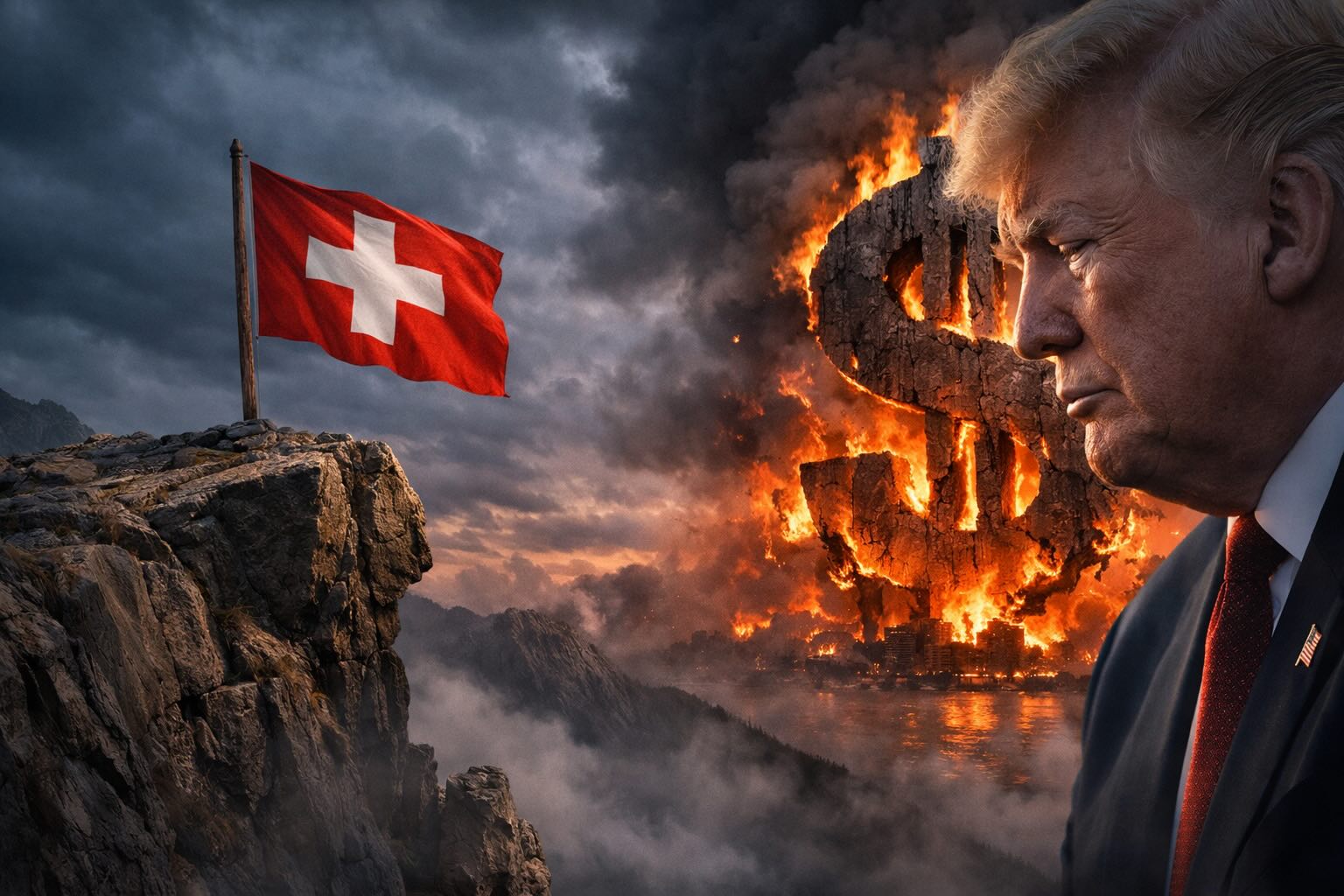
While missiles fly across the skies of the Middle East, hundreds of billions of Swiss reserves continue to feed the American financial heartland. Technical coincidence... or strategic contradiction? If neutrality is the pillar of our prosperity, then one question must be asked: is our national balance sheet still in line with our principles?
This weekend, the military escalation between Washington and Tel Aviv against Iran crossed a new threshold.
Gulf under power.
Strait of Hormuz under threat.
Opep+ forced to adjust its production (+206,000 barrels/day announced for April).
The geopolitical risk is no longer marginal.
It is becoming structural.
Meanwhile, Switzerland remains massively exposed to the financial heart of the world's leading military power.
The facts and figures
At 31 December 2025 :
-
Foreign currency reserves: ~CHF 750 billion
-
USD share: ~37 %
-
Exposure to US assets: >CHF 360 billion
-
Around 25 % invested in equities (passive index replication)
In concrete terms :
⮕ Treasuries finance the US Treasury deficit
⮕ Equities support US large caps
⮕ Our stability depends largely on a single geopolitical bloc
This is not neutral.
It's a strategic concentration.
Credible neutrality or theoretical neutrality?
As the writer Ferdinand Lips, a former banker and author of Gold Wars :
«He who controls the currency controls the nations.»
The dollar has become an instrument of power.
Extraterritorial sanctions.
Asset freeze.
Financial pressure.
Massive dependence on such a system creates structural vulnerability.
Lips also reminded us:
«Gold is the currency of kings, silver that of gentlemen, but debt is the currency of slaves.»
A neutral central bank cannot ignore this historical reality.
The risks are clear
1. Geopolitical risk
Prolonged escalation = shock on US markets = direct impact on our reserves.
2. Risk of monetary constraint
Access to the dollar system depends on American sovereign decisions.
3. Systemic risk
Excessive concentration = excessive fragility.
4. Consistency risk
You can't proclaim neutrality while being financially tied to a single pole of power.
As the J.P. Morgan before the US Congress in 1912:
«Gold is the currency. Everything else is credit.»
What sovereign prudence dictates
It's not about ideology.
This is strategic architecture.
1. Massive gold purchases by the SNB
Gold is nobody's debt.
It is neither sanctionable nor printable.
In a fragmented world, it is once again the neutral asset par excellence.
The SNB must :
- Significantly increase its gold reserves
- Gradually rebalancing the weight of the dollar
- The precious metal as a pillar of stability
Credible neutrality is based on non-aligned assets.
2. Creation of a Swiss sovereign wealth fund
Switzerland still does not have a genuine strategic sovereign wealth fund.
Members of the federal parliament need to get the ball rolling.
Objectives:
- Isolating part of structural surpluses
- Investing in diversified strategic assets
- Reducing systemic dependence
- Providing a long-term vision for our assets
Norway, Singapore and the Emirates have structured their financial sovereignty.
The Confederation cannot stand back.
Conclusion
Neutrality cannot be decreed.
It is built into the balance sheet.
As long as more than CHF 360 billion of Swiss assets flow into the US market, our independence remains partial.
Buying gold.
Create a sovereign wealth fund.
Reduce systemic exposure.
Sovereignty begins with monetary architecture.
Political courage begins with a simple act:
disengage Switzerland from the indirect financing of foreign conflicts.