
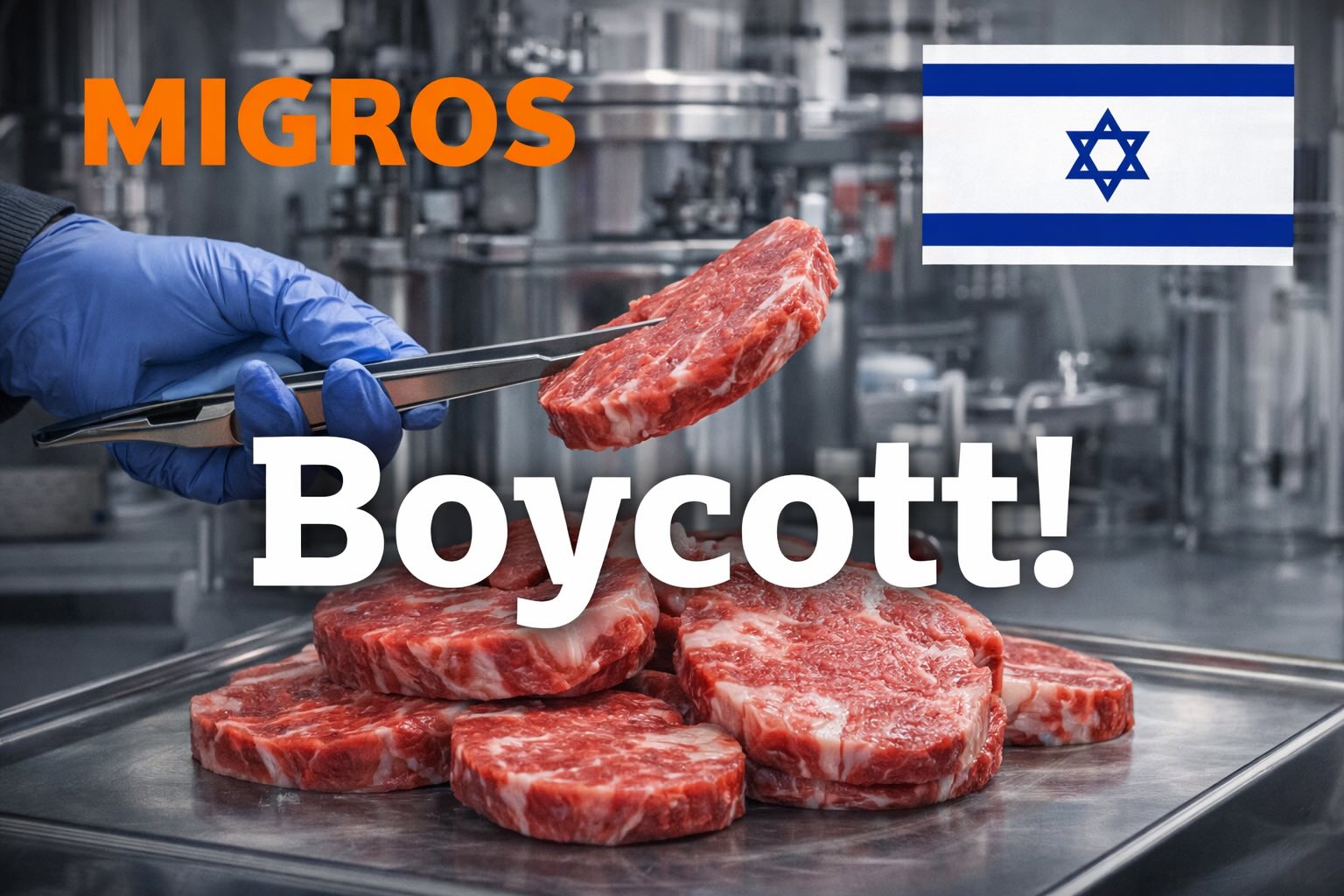
Migros now wants to produce steaks... without cows. In Kemptthal (ZH), the renowned cooperative is backing a project to cultivate meat in a laboratory from bovine cells, in partnership with the Israeli start-up Aleph Farms and the flavour giant Givaudan. Hailed as a major food innovation, this initiative nevertheless raises a fundamental question: how has a cooperative supposed to champion Swiss agricultural quality and tradition come to promote food made in industrial vats? Behind the technological discourse, there may be a much deeper transformation of our diet.
For decades, Migros has presented itself as the great Swiss popular cooperative. An institution meant to defend quality, proximity, and food trust. But today, the brand is taking a new, worrying step: supporting the introduction of lab-grown meat in Switzerland, in partnership with the Israeli company Aleph Farms and the flavour giant Givaudan.
In Kemptthal (ZH), the objective is clear: to produce artificial steaks from Cultured bovine cells in bioreactors. A technological promise sold as «sustainable» and «innovative». But behind the marketing blurb lies a simple question: Since when does food have to come out of a laboratory instead of a field or a farm?
Migros seems to forget a reality that consumers know well: the quality of many of the brand's processed products is already widely contested. The heavy use of additives – those famous “Something” – has become an industrial hallmark of ultra-processed food. Thickeners, stabilisers, flavour enhancers: a food chemistry that is distancing consumers ever further from real food.
And now, we're being told that the next step of progress involves cultivating meat in vats.
As the American essayist Michael Pollan reminds us:
«Don't eat anything your great-grandmother wouldn't recognise as food.»
Faced with a steak produced in a laboratory from artificially multiplied cells, the question deserves to be asked.
This evolution also presents a major economic and cultural challenge. Switzerland has mountain agriculture, livestock farmers, culinary traditions, and local supply chains. Introducing synthetic meat means opening the door to even more radical industrialisation of food, concentrated between a few biotech multinationals and agro-industry giants.
French philosopher Dominique Bourg summarises this dilemma well:
«A society that completely processes its food loses its connection with the living world, little by little.»
Migros should ponder this phrase.
Because a co-operative is not supposed to turn consumers into food safety testing. It should champion transparency, quality, and local producers — not become the European showcase for industrial experimentation from laboratories.
Conclusion
After aisles saturated with ultra-processed products and additives, Migros now seems ready to cross a new frontier: gradually replace agriculture with food biotechnology.
But a question will always remain:
Does Switzerland really want to become the artificial food testing ground ?
Because innovation isn't always progress. Sometimes it's simply one more step towards rootless, terroir-less, and trust-less food.