What if we were being sold the idea of giving up part of our sovereignty on the basis of biased studies? For years, the Federal Council and certain business circles have been conjuring up disaster scenarios to push Switzerland towards an institutional agreement with the European Union. But behind the alarmist figures and opaque economic models lurks a much less obvious reality: the automatic adoption of European law would directly threaten our direct democracy, our economic flexibility and the independence that has made Switzerland strong. New economic analyses are now cracking this official narrative. And they raise an essential question: who has an interest in exaggerating the benefits of this agreement?
For several years now, the Federal Council and certain business circles have been trotting out the same worst-case scenarios: without a new institutional agreement with the European Union, Switzerland would become poorer, lose market access and see its economy decline. These assertions are largely based on questionable economic models and biased political assumptions. Today, even economists commissioned by entrepreneurs are sounding the alarm: the benefits of agreements with the EU would be grossly overestimated, while their political and institutional costs are carefully minimised.
The study by economists Mark Schelker (University of Fribourg) and Michael Funk for the association Autonomiesuisse, presented in Bern on 10 March 2026, methodically dismantles the official argument. In particular, it calls into question the reference study commissioned by the Federal Council from the firm Ecoplan (2025), which claims that an erosion of the Bilaterals I would result in a loss of 4.9 % of Swiss GDP by 2045.
But this spectacular figure is based on a fundamental confusion: it mixes overall economic growth with the well-being of residents.
According to the analysis presented in Berne, most of this fall is due to a reduction in immigration and the number of cross-border commuters. In practical terms, the loss of income per capita would only be around 0,9 %, This is a far cry from the catastrophic scenario presented in official communications.
As Mark Schelker explained:
«The loss of per capita income estimated by the Ecoplan study is greatly overestimated due to methodological confusion.»
In other words, the central economic argument used to push Switzerland towards an institutional agreement is based on a questionable statistical construction.
The real issue: institutional sovereignty
But beyond the figures, the problem is above all political and constitutional.
The core of the draft framework agreement is based on a mechanism of dynamic take-up of European law. In practical terms, when the EU changes its legislation in the areas concerned, Switzerland would automatically have to adapt its law.
But this logic is in direct conflict with the foundations of our institutional order.
La Federal Constitution (art. 140 and 141) guarantees the people and the cantons the right to vote on important legislation by means of a referendum. Introducing a system where foreign legislation is progressively imposed on pain of sanctions would be tantamount to short-circuiting direct democracy.
The law professor Dietrich Schindler already reminded us:
«Direct democracy presupposes that the people can decide on their own laws. Automatically adopting foreign law undermines this fundamental principle.»
Such a mechanism would create permanent pressure: each popular vote could trigger retaliatory measures or the suspension of agreements.
Democracy would then become conditional.
Labour market flexibility under threat
The study presented in Berne also highlights a point that is often overlooked: the political concessions needed to get the agreement accepted are weakening one of Switzerland's main economic assets.
To make the package politically acceptable, the Federal Council has included new wage protection and regulatory measures, negotiated with various interest groups.
The result: more bureaucracy and less flexibility in the labour market, which is one of the pillars of Swiss competitiveness.
Ironically, in the name of European competitiveness, there is a risk of destroying one of the comparative advantages that have made the Swiss economy so successful.
The myth of the “guillotine clause”
Another central element of the official rhetoric is that if Switzerland refuses the agreement, the Bilaterals I would automatically disappear via the so-called «guillotine» clause.
However, this assumption is disputed.
The Autonomiesuisse study estimates that its activation would be highly unlikely, It would also result in significant losses for the European Union.
Switzerland remains the EU's fourth largest trading partner.
Economic relations between Switzerland and Europe are based on mutual interests, not a permanent ultimatum.
Independence is not an economic handicap
From Alfred Escher to the present day, Swiss prosperity has been built on a rare combination: political independence, neutrality, federalism and open trade.
The former Chairman of the SNB Thomas Jordan reminded himself:
«Switzerland's strength lies in the quality of its institutions and its ability to adapt.»
It is precisely this institutional model that the framework agreement jeopardises.
Transforming Switzerland into automatic reception of European law would mean gradually abandoning what has made it unique and successful.
Conclusion
The revelations of the study presented in Berne are not simply an academic debate. They show that the economic argument that has been used for years to push Switzerland towards an institutional agreement with the EU is based on fragile projections and questionable assumptions.
But above all, they remind us of a fundamental fact:
it's not just a question of economics.
It is institutional, democratic and civilisational.
By seeking to impose the automatic adoption of European law, certain political and economic leaders are crossing a constitutional red line.
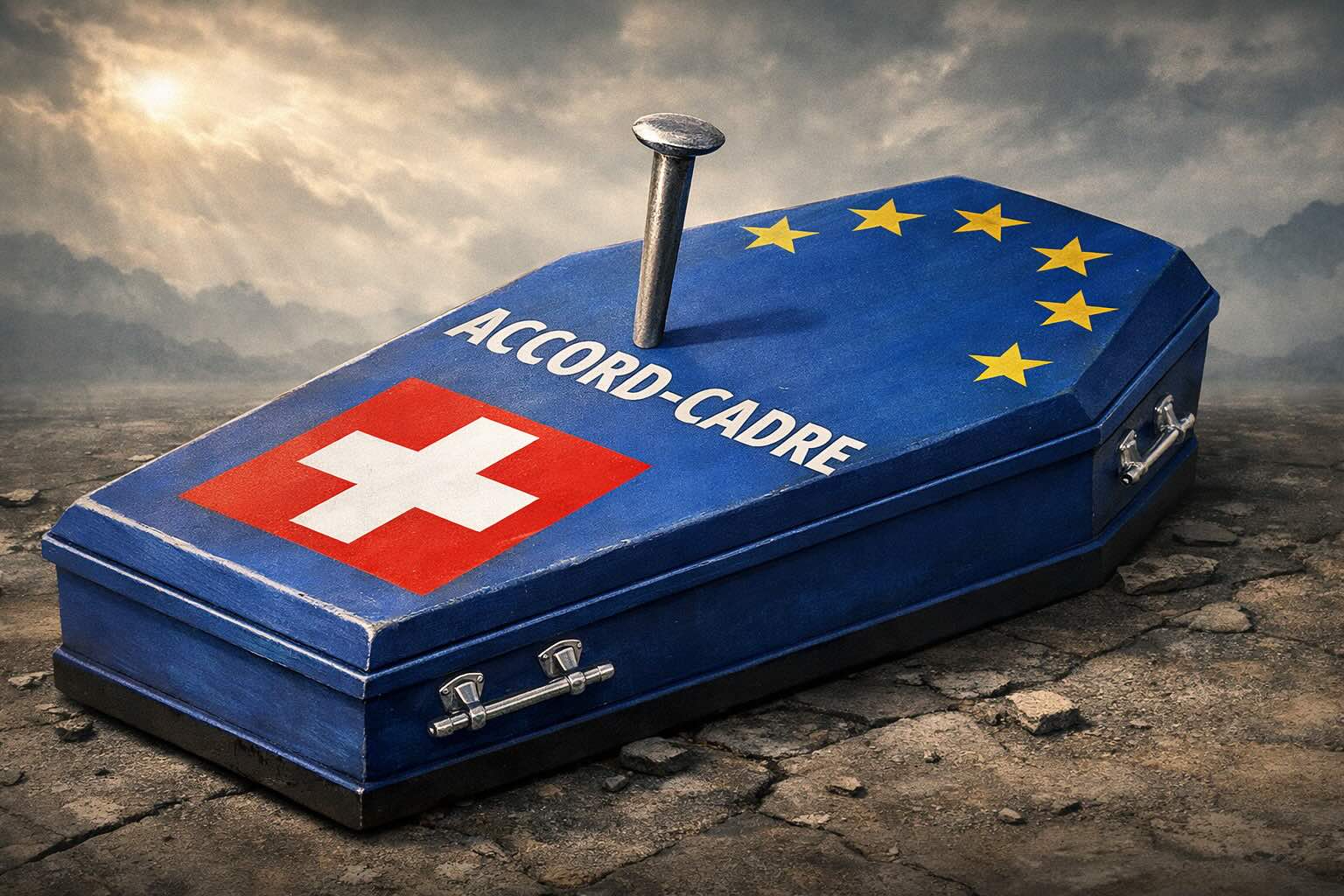
This episode is a an extra nail in the coffin of the framework agreement.
Switzerland is perfectly capable of cooperating with Europe.
But it must never submit to it.