
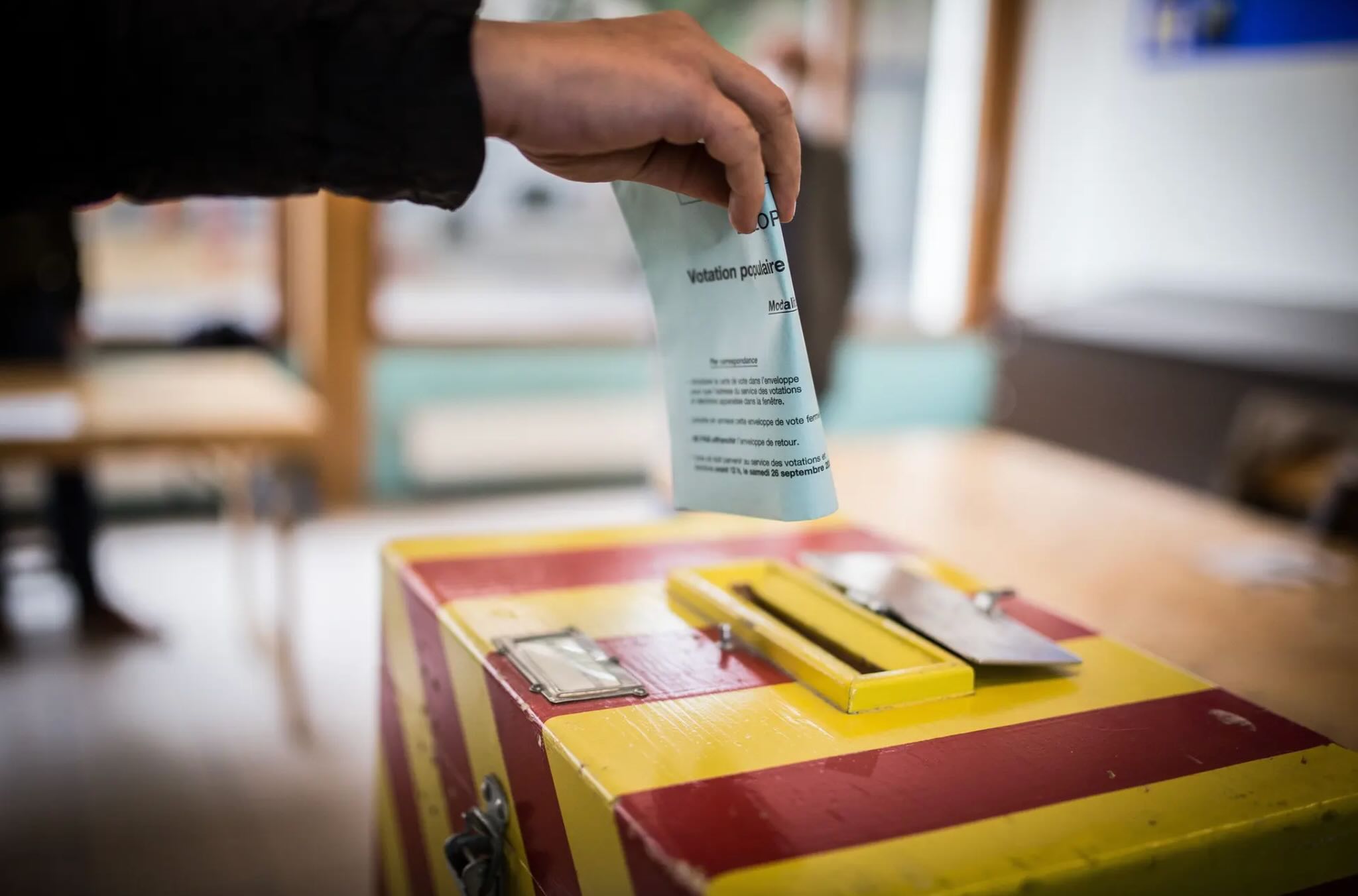
The votes on 8 March reveal a troubling paradox: while Switzerland claims to be one of the most successful models of direct democracy in the world, some of the results show just how far the country has come. political formulation, counter-projects and institutional semantics can influence public perceptions. Between the rejection of initiatives, the massive acceptance of counter-projects and sometimes contradictory decisions, one question deserves to be asked straightforwardly: Is our democracy still fully guided by an understanding of the issues at stake... or is it gradually becoming more vulnerable to political and administrative engineering mechanisms?
Direct democracy under influence? The votes on 8 March raise some fundamental questions
The results of the federal referendum on 8 March deserve a lucid analysis.
A number of important issues were put to the Swiss people, with the following results:
-
Initiative «Cash means freedom» : 54.39 % of non
-
Direct counter-proposal on cash : 73.39 % of yes
-
Initiative «200 francs is enough» (SSR) : 61.95 % of non
-
Initiative for a climate funds : 70.71 % of non
-
Law on individual taxation : 54.26 % of yes
Taken in isolation, these results may seem to reflect the usual diversity of Swiss popular decisions. But taken together, they also reveal a worrying trend: the population is becoming increasingly permeable to the mechanisms of political and semantic engineering.
The battle of words: the revealing example of cash
The most striking case is that of the «Cash means freedom».
On the one hand, the initiative is rejected.
On the other, the counter-proposal was overwhelmingly accepted by 73 %.
This paradoxical situation reveals a classic problem of political strategy: the power of semantic framing.
As George Orwell :
«Political language is designed to make lies believable and murder respectable, and to give the appearance of solidity to wind.»
The counter-proposal gives the impression of protecting cash, when in fact it above all, introduces a legal mechanism for organising its future management. Many voters probably voted for what they saw as a guarantee, without realising the long-term legal implications.
This phenomenon is well known in political science: when a question is reformulated by authority, perception changes profoundly without the substance necessarily being the same.
A society more sensitive to political engineering
The votes on 8 March confirm a trend that can be observed in many democracies: public opinion is becoming more susceptible to influence through institutional arrangements, communication and the wording of ballot items.
The historian and philosopher Gustave Le Bon wrote:
«Crowds don't reason, they react to images and words.»
Of course, this does not mean that Swiss citizens are not thinking. But the media, institutional and narrative context in which objects are presented strongly influences decisions.
In a system of direct democracy, this confers immense responsibility on those who draft texts, counter-projects and official campaigns.
A key issue: the transparency of the voting process
There is another issue that needs to be addressed without taboo: complete transparency of the vote compilation process, particularly when electronic systems are involved.
Switzerland has solid institutions. But democratic confidence is not based solely on tradition - it is also based on the rule of law. it is based on verifiability.
Many countries have experienced major controversies surrounding their electoral processes:
-
United States The debate on voting machines and counting procedures is a recurring one.
-
France phasing out of certain electronic machines following criticism of their auditability.
-
Germany In 2009, the Constitutional Court ruled that voting machines must allow citizens to understand how they vote.
The basic principle is simple:
Democracy must not only be honest - it must be controllable.
As the saying goes James Madison, one of the founding fathers of modern constitutionalism:
«If men were angels, no government would be necessary.»
Preserving the credibility of direct democracy
Switzerland has one of the most advanced democratic systems in the world. But its strength rests on two essential pillars:
-
Clarity of the items put to the vote
-
Absolute confidence in the integrity of the process
In an international context marked by political polarisation, information manipulation and geopolitical tensions, these two elements must be protected with the utmost vigilance.
This involves :
-
transparent drafting of counter-projects,
-
accessible legal education for the general public,
-
and independent control mechanisms over the vote compilation process.
Conclusion
The votes on 8 March do not constitute a democratic crisis. But they do send a clear signal.
Swiss direct democracy remains a unique institutional treasure.
But to ensure that it continues to function to the full, citizens must remain attentive to the mechanisms of political formulation and demand total transparency in the electoral process.
Democracy is not just about voting.
It is based on and confidence in the integrity of the system that transforms these votes into decisions.