
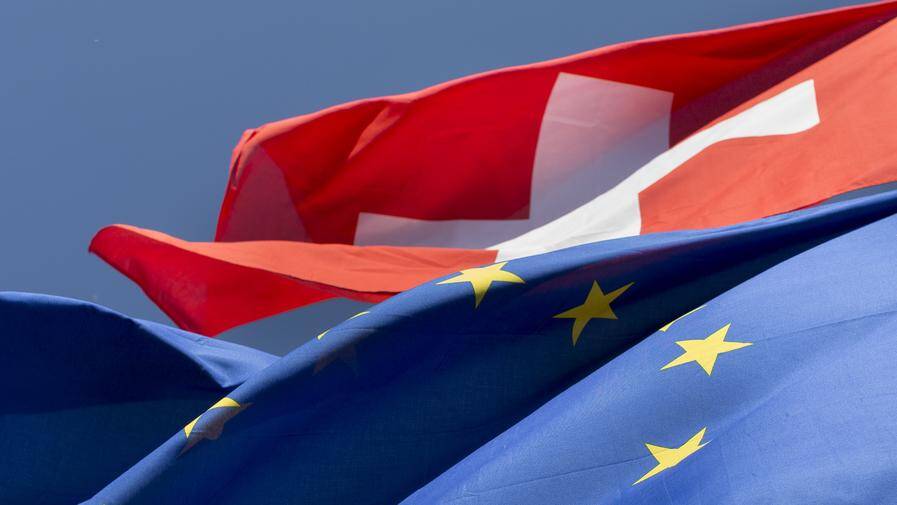
For months, the debate has been presented as an economic no-brainer: without the new agreements with the EU, Switzerland would be taking a major risk to its prosperity. But what do the figures and independent analyses really say? When two leading Swiss economists come to opposing conclusions, one thing becomes clear: the choice is not technical, it is institutional - and its consequences go far beyond simple trade.
On 13 February 2026, the Neue Zürcher Zeitung confronted two leading Swiss economists on the 2024 integration agreements with the EU: Aymo Brunetti, favourable to treaties, and Christoph Schaltegger, more reserved.
The contrast is illuminating. And deserves to be taken seriously.
1. Agreements that go far beyond trade
According to Schaltegger, «these new agreements have little to do with trade». The core of the arrangements would be institutional: dynamic adoption of European law, sanction mechanisms, extension of the scope of application.
So the issue is not tariffs - it's constitutional.
But even on the economic front, the guarantees are weak. The example of the research programme Horizon Europe is telling: there is no lasting legal certainty, and the possibility of exclusion remains a political lever. Recent experience has shown that participation can become an instrument of pressure.
2. Prosperity barely affected... according to the official study
The key point is that the study commissioned by the Federal Council indicates that the impact on prosperity would be limited.
If the economic effect is marginal, then the cost-benefit balance changes radically.
Schaltegger puts it clearly: «The impact on our prosperity would be minimal. But the disadvantages would be considerable.»
What are the drawbacks?
- Obligation to adopt EU law or face sanctions
- Reducing the democratic margin
- Significant extension in crucial areas such as the free movement of persons and the directive on citizens' rights
In other words: a transfer of political autonomy for uncertain economic gain.
3. The risk of an institutional trap
Switzerland thrives because its institutions are simple, down-to-earth and adaptable.
A system based on the dynamic adoption of the law creates asymmetrical dependence: Swiss companies would no longer directly influence the standard, but would have to comply with it.
Certainly, some major economic organisations see an advantage in this: harmonisation simplifies structures. But is administrative simplicity for a few major players worth giving up a national capacity for adjustment?
As Schaltegger points out, this would be a growth factor... «if European regulations were competitive». But this still needs to be demonstrated.
4. The ignored alternative
There is another way: a modernised free trade agreement, without institutional straitjackets, comparable to the EU-Canada model (CETA).
Why should this option be dismissed as unrealistic?
Fatalism is not a strategy.
Conclusion
If the economic benefits are low and the institutional concessions high, then the calculation becomes crystal clear: the game is not worth the candle.
The question is not whether we are “for” or “against” Europe. It is a question of whether Switzerland should exchange its capacity for self-determination for a promise of stability that the texts themselves do not guarantee.
Switzerland's prosperity is not based on market access alone.
It is based on stable, predictable and democratically-controlled institutions.
And that's priceless.
🇨🇭Ce that the media keep quiet, we analyse. What Berne negotiates, we dissect. Join our HQ on Telegram now: https://t.me/swisssovereignty