
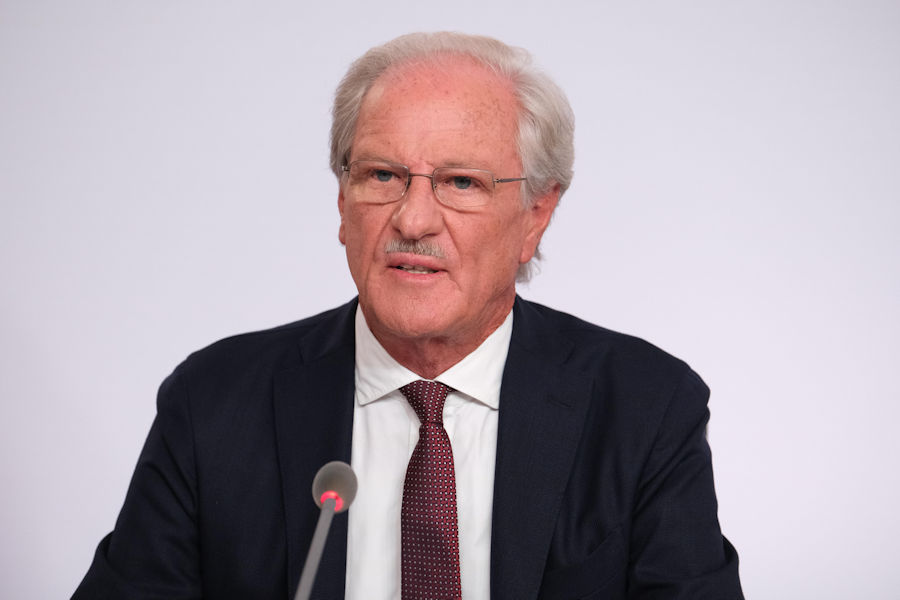
At a time when the debate on Swiss-EU integration agreements is intensifying, a voice from Europe's highest industrial level is disturbing the prevailing consensus. In an interview with Die Weltwoche (15 February 2026), Wolfgang Reitzle - an experienced executive with a thorough knowledge of the EU's economic and legal structures - warns against a development that would go far beyond mere commercial cooperation.
His point is not about market access, but about something more fundamental: the compatibility between the EU's legal system and the Swiss institutional model based on direct democracy.
Source : Die Weltwoche, 15 February 2026
(Translation of an interview with Wolfgang Reitzle)
A leading German executive based in Switzerland is sounding the alarm.
And these are not the words of a fringe opponent or a political activist.
Wolfgang Reitzle - former Chairman of the Board of Directors of LafargeHolcim, member of the Supervisory Board of Deutsche Telekom and current Chairman of the Supervisory Board of Continental AG - knows Europe's industrial and institutional workings inside out.
His assessment of the 2024 integration agreements between Switzerland and the EU is crystal clear:
the risk is not commercial. It is systemic.
1. A false commercial debate
In his view, Switzerland could perfectly well conclude targeted sectoral agreements with the European Union.
The real question is elsewhere:
Why should the entire Swiss population be subject to the EU's legal system?
Switzerland is not a member of the EU.
It does not elect the Commission, the European Parliament or the judges of the Court of Justice.
The new mechanisms provide for a dynamic alignment of the law, with a central role for the Court of Justice of the European Union in the event of a dispute.
We're no longer talking about market access here.
We are talking about a normative hierarchy.
2. The institutional question: direct democracy vs. external primacy
Reitzle's criticism has far-reaching consequences:
The Court of Justice not only rules on the law; it also acts as the Commission's implementing body.
Whether or not we agree with this assessment, one fact stands out:
- In Switzerland, popular sovereignty allows for initiatives and referendums.
- In the EU, the law takes precedence over national constitutions.
- The decisions of the CJEU are binding and final.
The tension is obvious.
Can we maintain a participatory model based on direct democracy if, in the event of a conflict, the final arbitration is out of the hands of Swiss institutions?
3. Bureaucracy and competitiveness: an under-researched debate
The other criticism that has been levelled concerns bureaucratisation.
Some useful figures to put things into context:
- In 2025, the European Commission introduced more than 1,400 legislative acts (the most since 2010).
- German companies are denouncing a growing regulatory overload.
- The proportion of SMEs in the Swiss economy (more than 99 % of companies) makes the country particularly sensitive to standards inflation.
Swiss competitiveness is based on :
- legal certainty,
- rapid decision-making,
- fiscal stability,
- and relatively light administration.
Any automatic import of foreign law automatically raises the question of the cost of compliance.
4. The heart of the matter: decision-making independence
The debate is not emotional. It is institutional.
Switzerland is :
- a federal state,
- semi-direct democracy,
- a system based on subsidiarity and internal compromise.
The EU is :
- a supranational construction,
- based on the primacy of European law,
- structured around a powerful executive (Commission).
These two approaches can work together.
But can they merge without altering one of them?
Reitzle speaks of a «system of excessive bureaucratisation» that could, in the long term, weaken Swiss independence.
We can debate the tone.
But the question needs to be asked seriously.
What the debate should really look at
✔️ Which sectors really require dynamic alignment?
✔️ Are there purely commercial alternatives?
✔️ What impact would this have on future popular initiatives?
✔️ What institutional safeguards are really binding?
✔️ Has the cost/benefit ratio been objectively quantified?
Conclusion: choosing a civilisation model
At the end of the day, it's not just about economics.
It is the Swiss model itself:
A country where citizens can correct the political elites.
A country where legitimacy comes from the popular vote.
A country that has never delegated its ultimate arbiter to an outside jurisdiction.
The question is not :
«To be for or against Europe.»
The question is:
Does Switzerland want to remain the architect of its own rules - or become the local administrator of an external legal order?
The debate is open.
But it must finally be conducted without taboos.
🇨🇭Ce that the media keep quiet, we analyse. What Berne negotiates, we dissect. Join our HQ on Telegram now: https://t.me/swisssovereignty