
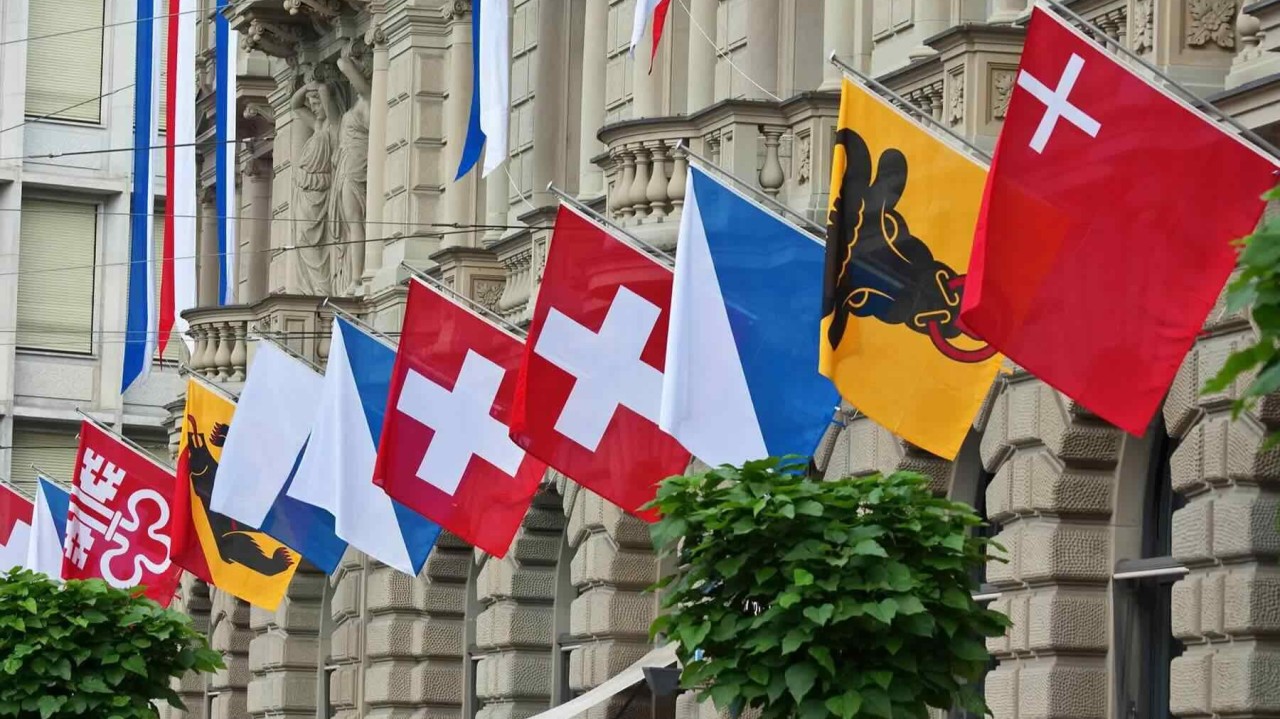
You don't kill Swiss federalism with words - you smother it with standards. Harmonisation“ here, ”bringing into line“ there, ”technical alignment“ elsewhere... and, without a clear vote, without a clear break, the cantons slip from sovereign to mere executors. The most worrying thing is not centralisation per se: it's the constant pretext for it. Because behind the standardisation of rules, constraints and procedures, there is a single goal: to make Switzerland ”compatible“, ”equivalent“, ”integrable“ - in other words, to set it on the gentle slope towards integration with the EU.
Federalism is not Swiss folklore. It is an architecture of freedom. The Constitution is clear: «The cantons are sovereign...».» (art. 3). And yet, year after year, the same thing happens: harmonise, standardise, standardise - to the point of transforming the cantons into mere enforcement offices.
This movement is not neutral. It follows a very clear compass: gradual integration into the European Union's internal market, In other words, it's not a matter of formal adhesion, but of piling on “compatibilities” and imposed “updates”.
1) Federalism, officially sovereign... practically under trusteeship
The Confederation and the cantons themselves recognise that the division of tasks has become a tangle: a major “disentanglement” project was relaunched in 2024, with a joint mandate from the Confederation and the cantons, proof that the machine has gone haywire. .
In other words: we centralise, Then we're surprised that everything overlaps, then we create a project to “clarify”... while continuing to centralise elsewhere.
2) Internal harmonisation: the precedent that standardised everything
Even without Brussels, the technique is familiar: autonomy is proclaimed, then a “minimum” framework is set, which becomes the maximum.
Case in point: tax harmonisation. The LHID explicitly states that it designates the direct taxes that the cantons must levy and sets out the principles governing cantonal law. We are not abolishing the canton: we are locks it into a mould.
Another example is schools. The concordat HarmoS is aimed at’harmonisation of compulsory education; It came into force in 2009 once the required threshold of cantons had been reached. Here again, cantonal competence is not being “destroyed”, but rather "restored". standardise - and federalist diversity is reduced to details.
3) The EU vector: integration through technology, not through voting
This is where the common thread becomes impossible to deny: when the objective is access to the internal market, harmonisation becomes a structural obligation.
A) MRA: equivalence of standards as a condition of access
The Switzerland-EU agreement on the removal of technical barriers to trade (MRA/MRA) is based on a simple principle: equivalence of prescriptions and mutual recognition of conformity assessments .
The result: to sell “frictionlessly”, you have to stick to the dominant partner's frame of reference - and that frame of reference is the EU.
This is not marginal: the MRA covers around twenty product categories, It has been associated with a very large volume of exports (order of magnitude: tens of billions). When such an economic mass depends on ’equivalence“, political pressure is mechanical: align, align, align.
B) Medical devices: the perfect example of “update” blackmail”
When the EU changes its rules (MDR), the “equivalent” relationship breaks down if the agreement is not updated: the European Commission explained that the medical devices chapter of the MRA operated on the basis of equivalent regulations, With the entry into force of the MDR (26 May 2021), the framework changes. .
Swissmedic, for its part, would like to remind you of the specific nature and period of validity of the chapter in question. .
Plain language translation : if Switzerland does not update and align, it will lose fluid access. And to “update”, we often have to accept more intrusive institutional mechanisms.
C) Schengen/Dublin: resumption of developments and the need to adapt
In Schengen/Dublin, there is a procedure for taking over developments: revisions to EU law become binding on the associated states via this mechanism. The EDA stresses that Switzerland has a right to participate, but the dynamic remains that of a system in which the rules are made elsewhere .
4) The next stage: “institutional elements” = permanent harmonisation
The Federal Council itself wrote, in an explanatory document linked to the institutional agreement, that it wished to «optimal integration into the EU internal market».» . It's not a rumour: it's a clear direction.
And the “institutional elements” are designed precisely to ensure that agreements are regularly updated, The EDA formulates it as a guarantee that “the same rules apply” in the common internal market. The EDA also formulates it as a guarantee that "the same rules of the game" apply in the common internal market .
Here, the debate is no longer technical. It is constitutional: constant updating of the law to remain “compatible”.” inevitably ends up narrowing the scope for cantonal decision-making - and, with it, real political freedom.
Conclusion: federalism doesn't just die - it dies out through “compatibility”.”
No one will ever say to you: “We are abolishing federalism”.”
You will be told: “Harmonisation”. “Upgrading. ”Legal certainty. “Equivalence. ”Same rules of the game.“
But the result is the same: a Switzerland that is de facto integrated, The cantons become the executors of a law they did not write. And cantons that become the executors of a law they did not write.
The time has come to draw a simple red line: economic access cannot be used as a Trojan horse for political dispossession.
Federalism is not an administrative cost. It is our institutional insurance policy. And you don't “standardise” life insurance: you defend it.
We analyse what the media keep quiet. What Berne negotiates, we dissect. Join our HQ on Telegram now: https://t.me/swisssovereignty