
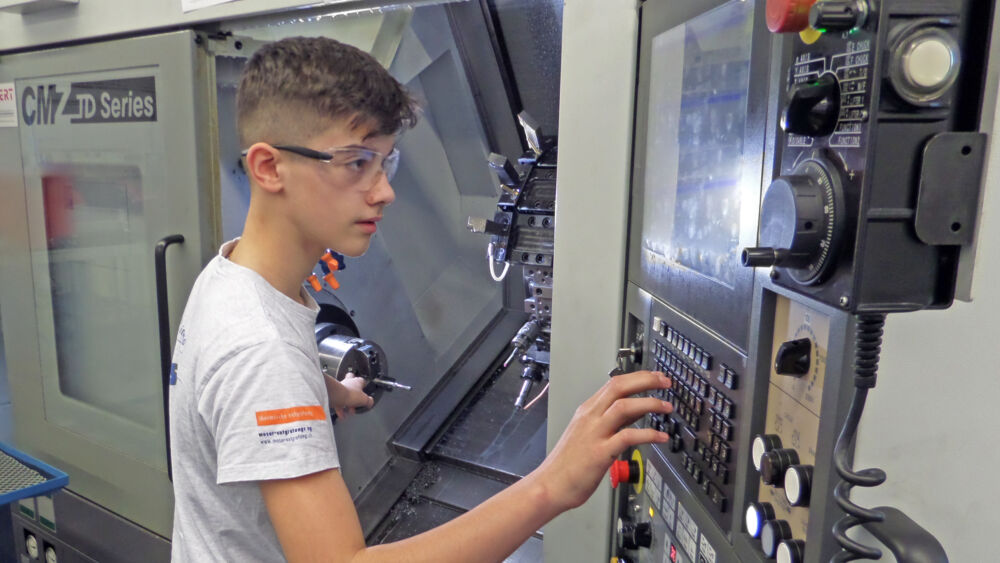
For decades, apprenticeship has been one of the Confederation's greatest success stories: an effective social lift, a guarantee of dignity through work and a pillar of economic prosperity. The Federal Certificate of Competence embodied this unique Swiss promise, based on competence, effort and local roots. But for more than twenty-five years, this model has been silently eroding. Behind all the talk of «mobility», ’openness« and »modernisation«, the CFC has been gradually downgraded, exposing young people trained in Switzerland to constant competition and weakening one of the most solid foundations of our social cohesion. This downgrading is neither accidental nor cultural: it is the product of specific political, legal and economic choices that can no longer be ignored.
by Luc-André Meylan, economist and columnist for Souveraineté Suisse
The silent downgrading of a pillar of productive Switzerland
For decades, the certificat fédéral de capacité (CFC) was one of the most solid pillars of the Swiss model. It offered a path of excellence outside the academic world, guaranteeing rapid professional integration, economic stability and social recognition. Apprenticeship embodied the Swiss promise: a direct link between educational effort, the value of work and individual autonomy.
That promise has now been broken.
Contrary to the prevailing view, the decline in the CFC is not due to a lack of interest among young people or a cultural contempt for manual occupations. It is the product of precise political, legal and economic choices, These have gradually dismantled the protective value of Swiss vocational training.
An organised structural changeover
At the end of the 1990s, Switzerland embarked on a series of alignments that profoundly reconfigured its education system and labour market.
Le Bologna Process imposed the Bachelor's-Master's-Doctorate system, the modularisation of courses and the credit system. Under the guise of harmonisation, it has weakened content requirements, standardised courses and sent out a clear signal: the academic route will henceforth be the reference standard.
At the same time bilateral agreements I, With the introduction of the free movement of people, the scarcity of Swiss qualifications was eliminated. Diplomas and CFCs have been thrown into permanent competition with an abundant, mobile and often cheaper European workforce. The Bilateral II have extended this dynamic by making research, funding and cooperation conditional on increasing alignment with standards.
La Lisbon Recognition Convention and the adoption of the European Qualifications Framework (EQF) have enshrined the legal equivalence of foreign diplomas, replacing real relevance to local needs with abstract comparability of formats. The constant influence of the OECD, via PISA and the doctrine of human capital, has completed the transformation of schools into tools for managing employability rather than places where knowledge is demanded and transmitted.
Taken together, these schemes have substituted conformity to excellence, from mobility to protection, flow management for skilled labour training.
Twenty years of downgrading the CFC
Until the turn of the millennium, a CFC paved the way for clear career paths: salary progression, contractual stability, lasting integration into the local economic fabric. Apprenticeships enabled people to build a life free of debt and prolonged insecurity, and contributed directly to social cohesion.
Today, holders of a CFC enter the job market as saturated and ultra-competitive. In addition to young people trained in Switzerland, there are experienced cross-border workers, foreign graduates who are recognised almost automatically, and applicants who accept lower salary conditions.
In almost half of the professions where there are no collective agreements, this competition takes place without any safeguards. Since the early 2000s, wage cuts of up to 50 % have been observed in certain non-agreement occupations. The exchange rate differential between the Swiss franc and the euro is exacerbating the pressure, particularly in border regions.
For young people, the consequences are concrete: temporary contracts, low starting salaries, discontinuous careers. Access to economic independence and family stability is becoming the exception rather than the norm.
SME trainers caught in a trap
The downgrading of the CFC also weakens training companies, particularly SMEs. Training an apprentice represents a real investment in terms of time, supervision and responsibility. Historically, this effort was offset by the loyalty of skilled employees, trained according to the company's specific needs.
This logic is now broken. An SME that hires a young person with a CFC immediately puts him or her in competition with an external workforce, which is often cheaper and immediately operational. For equivalent perceived skills, economic rationality favours flexibility and price, not local training.
Result: companies are struggling to recruit apprentices but are reluctant to hire them on a long-term basis. The system seizes at the top and at the bottom.
Bologna and the implicit hierarchy of career paths
The message to families is clear. By establishing the Bachelor's degree as the benchmark and bringing universities of applied sciences closer to the university model, the Bologna process has established an implicit hierarchy of career paths.
In the middle classes, the choice of gymnasium and higher education is not a rejection of technical professions; it's a decision to pursue a career in a technical field. rational protection strategy in an environment that has made learning economically more risky.
An upgrade impossible without a break
Upgrading the CFC is economically desirable. But as long as the framework of bilateral agreements remains unchanged, such an upgrade is largely illusory.
The free movement of people, combined with the almost automatic recognition of diplomas and the exchange rate differential, exerts permanent structural pressure on wages in occupations accessible after a CFC. Any attempt to raise wages is neutralised.
Of course, vocational training needs to evolve. Systematically linking CFCs with skills in IT, applied engineering and the controlled use of artificial intelligence is a step in the right direction. survival requirement in a digitalised economy. But this increase in skills, however necessary it may be, will not be enough.
Even if it is technologically strengthened, the CFC will continue to be downgraded as long as the scarcity of Swiss skilled labour is dissolved by a legal framework that organises widespread competition.
Restoring the sovereignty of training and work
Restoring the CFC's economic and social value requires a twofold decision: ambitiously modernising vocational training and make a political break with the framework that has weakened it.
This implies Reject bilateral III and’abrogate bilateral agreements I and II. Twenty-five years of alignment have produced unprecedented economic and social impoverishment, sacrificing learning, pay and stability in the name of idealised mobility.
Ending the bilaterals means restoring the scarcity of skilled labour, The aim is to restore purchasing power, enable SMEs to train and hire on a long-term basis, and give Switzerland back its identity. economic sovereignty.
The future of the CFC is not a technical detail. It reflects a societal choice: to preserve a model based on the value of work and the transmission of know-how, or to accept their dilution in a market with no protection and no horizon.
🇨🇭 Without funding, there can be no resistance. Support Swiss Sovereignty now: https://souverainete-suisse.ch/faire-un-don/
We analyse what the media keep quiet. What Berne negotiates, we dissect. Join our HQ on Telegram now: https://t.me/swisssovereignty