
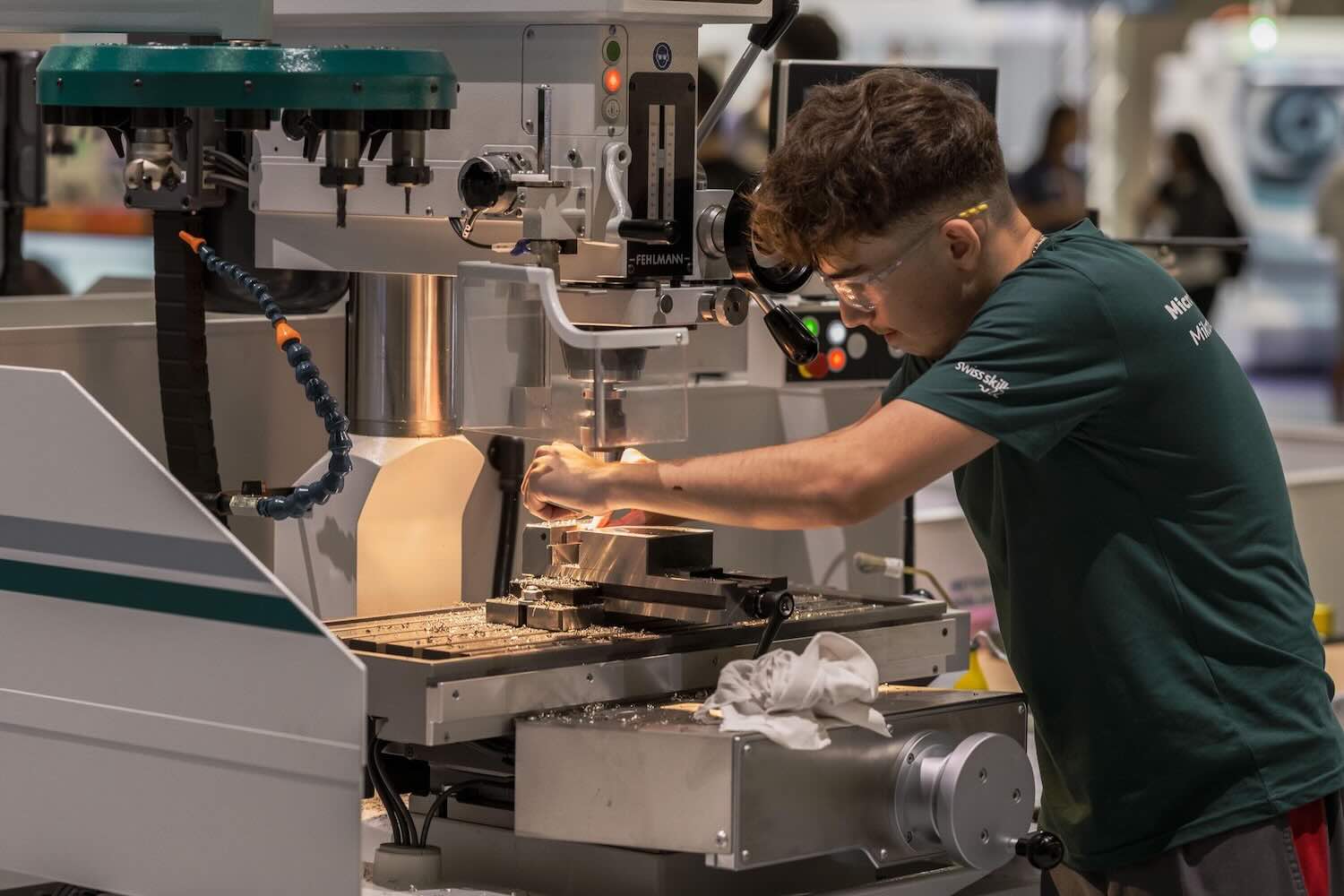
It's no coincidence that forum on apprenticeship, published in response to a question from National Councillor Nicolas Kolly, broke audience records.
When a subject strikes a deep, lasting chord, public opinion responds.
Because learning is not a secondary issue.
This is the the nuclear heart of the Swiss model.
And that heart is now under attack - slowly, methodically, ideologically.
Earlier and earlier guidance... and increasingly biased guidance
Today, children are asked to 12 or 13 years old to «choose their future».
In reality, it's not the children who choose - it's the parents who choose. parents, under social pressure.
The gym has become a status marker.
Apprenticeships: the default route.
The manual profession, an admission of failure.
In the past, orientation was based on objective criteria academic results, aptitudes, real potential.
There was no shame in not going on to higher education, because manual jobs offered an opportunity to learn a trade. concrete future, A clear motivation and social recognition.
Today, we refuse to make a decision.
We no longer want to frustrate.
We don't want to upset anyone.
But a society that refuses to establish hierarchies produces’Delayed failure.
The great academic illusion
But the figures are clear.
Switzerland has one of the the lowest youth unemployment rate in Europe (around 6-7 %), This is precisely because of its dual training system.
Conversely, countries that have sacrificed apprenticeships - France, Spain and Italy - are fluctuating between 15 and 25 % youth unemployment.
And yet, we are repeating the same scenario:
- diploma inflation,
- socialising« university courses with no real prospects,
- overqualified graduates... but underemployed.
We produce cohorts of brilliant young people on paper,
but disconnected from real work, Dependent, insecure, still living with their parents at the age of 25 - with no independence, no capital, no job.
The great contempt for manual jobs
A well-practised manual trade allows :
- economic independence,
- business creation,
- the transmission of knowledge,
- strong resilience to crises.
Conversely, how many tertiary professions will be crushed or profoundly reconfigured by AI in the next ten years?
And yet, the dominant message remains absurd:
«Become a lawyer, a computer scientist, a consultant... or you're nothing.»
That's not true.
It's dangerous.
It's anti-social.
A good craftsman can become independent.
A tertiary employee without concrete skills becomes interchangeable.
Companies are dropping out - and we refuse to see why
We often blame the bosses.
The reality is more uncomfortable.
Yes, there are abuses. Just like everywhere else.
But they are minority.
On the other hand :
- administrative constraints are exploding,
- the judicialization of the employment relationship is progressing,
- the relationship with authority is delegitimised from school onwards.
Many craftsmen have more like to take on apprentices :
Repeated lateness, absenteeism because of a cold, refusal to make an effort, permanent victim attitude.
Put yourself in the shoes of a self-employed person who is fighting for the survival of his business, which he built with his own strength.
Training an apprentice has become a risk, plus an investment.
The real blind spot: parental responsibility
It's a subject no one dares broach.
But the truth is simple:
⮕ The devaluation of learning begins at home.
It's the parents who pass it on:
- respect,
- the value of the effort,
- understanding money,
- courage,
- the idea that not everything falls from the sky.
Preparing your children for the future does not mean planning for them yesterday's world.
It means arming them for the real world that awaits them.
Apprenticeship is not a dead end - it's a springboard
We need to deconstruct a central lie:
⮕ apprenticeship doesn't lock you in. It opens up.
The Swiss model is based on gateways unique in Europe :
- CFC → professional maturity,
- maturité pro → HES,
- maturité pro or gymnasium → university,
- further training, diplomas, master's degrees, specialisations.
Apprenticeships enable :
- learn a real trade,
- to become autonomous,
- then to broaden his academic horizons - by choice, not by default.
Nicolas Kolly embodies this model
His question to the Federal Council is not ideological.
It is biographical.
Born into a family of Fribourg farmers, Nicolas Kolly :
- repeats primary school,
- chooses an apprenticeship in agricultural machinery mechanic,
- obtains its CFC at 19,
- serves two years at Pontifical Swiss Guard,
- then resumed his studies:
Today, he is :
- lawyer,
- Army officer (captain),
- former military examining magistrate,
- National Councillor.
⮕ That's what learning is all about.
EU and standardisation: the silent danger
The Swiss dual training model is a European exception.
It is based on subsidiarity, proximity to businesses and cantonal autonomy.
Joining the European Union automatically means :
- standardise,
- academicise,
- centralise,
- bureaucratisation.
⮕ Apprenticeships in Switzerland can be reformed.
⮕ It cannot be saved in Brussels.
Conclusion
The political courage of Nicolas Kolly is to be commended.
He speaks not as an ideologue, but as a man who has been there.
The downgrading of apprenticeships is not inevitable.
It's a cultural and ideological construct.
And what has been built can be undone.
But on one condition:
stop flattering,
stop feeling guilty,
stop lying to our young people.
Apprenticeships are not a plan B.
It is a springboard.
A base.
A Swiss path to excellence.
And there's still time to defend it.
Your opinion is essential for a lucid debate based on reality and the interests of young people. Is the downgrading of apprenticeships, especially in French-speaking Switzerland, linked to the free movement of people? 🗳️ Participate in survey on LinkedIn and share your views in the comments.