
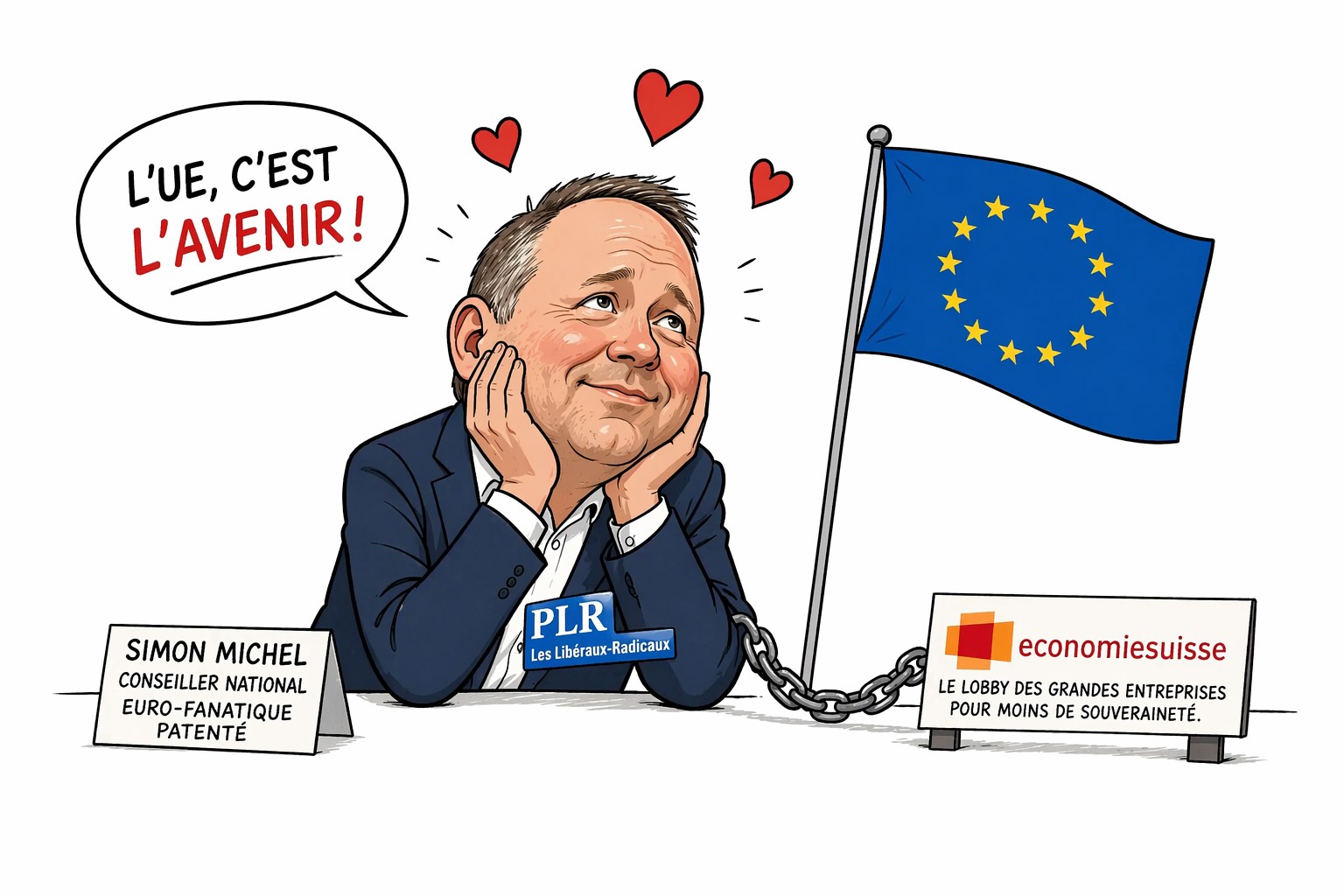
Under the guise of economic pragmatism, some politicians are today attempting to portray a profound transformation of our system as insignificant. Behind reassuring words and promises of stability lies a very different reality: a gradual, silent legal integration that bypasses democratic debate. The recent example of Simon Michel's statements is the perfect illustration of this – and deserves to be examined without filter.
The Misty Cleaver, 7 April 2026
In the debate on Swiss–EU relations, some speeches aim less to inform than to reassure. This is the case with the statements by Simon Michel, FDP National Councillor and member of the extended committee of economiesuisse.
Presented as educational, his assertions nevertheless do not stand up to rigorous legal and economic analysis. Point-by-point demonstration.
1. «Only Swiss law applies»: a misleading presentation
Simon Michel states that the agreements would merely transpose international commitments into Swiss law, which would remain sovereign.
This reading is incomplete.
The mechanisms under discussion rely precisely on a Dynamic repercussion of EU law in the areas covered. This implies:
- a continuous adaptation of Swiss law to European developments
- without Switzerland's participation in the EU's legislative process
- with limited and potentially penalised refusal margins
Swiss law thus becomes an instrument of enforcement, rather than an autonomous source of decision.
2. «EU regulations don't apply to us»: legally incorrect
Stating that European regulations do not apply to Switzerland is to ignore how bilateral agreements function.
In practice:
- sectoral agreements incorporate entire sections of European standards
- these standards produce binding effects, whether they are directly applicable or transposed
Above all, the case law of the Federal Tribunal is clear: in its 2015 ruling, it confirmed the primacy of the Agreement on the Free Movement of Persons over domestic law in the event of conflict.
In other words, even when “translated”, Swiss law defers to the international agreement.
3. «Local SMEs are not affected»: a reasoning detached from reality
Simon Michel claims that only exporting companies would be subject to European standards.
This distinction is artificial.
In an interconnected economy like that of Switzerland:
- The production lines are integrated
- the standards are rolled out to all suppliers
- Local businesses must align themselves to remain in the economic circuits
An SME that doesn't comply with dominant standards is simply sidelined, even if it doesn't sell directly to the EU.
4. «EU standards only apply to exports»: economically unsustainable
The idea of two coexisting normative systems - one for the Swiss market and one for exports - is not practical for industrial use.
Maintaining dual production lines is:
- costly
- complex
- Ineffective
Companies are therefore adopting standardisation, often aligned with European standards, which are becoming the de facto benchmark.
Even products intended for third-party markets (USA, Asia) are often designed according to these standards for optimisation reasons.
5. «Limited scope»: a minimisation of the stakes
Simon Michel suggests that the scope of the agreements would be limited.
However, the mechanisms envisioned include:
- the resumption of existing rules
- but also from all future derived law, as far as it is linked to the agreements
This potentially opens up a wide scope for:
- the agri-food industry
- energy
- transport
- health
- other strategic sectors
This is not a static framework, but an evolving system.
6. The Democratic Blind Spot
The heart of the matter remains elusive.
The dynamic review of the law implies:
- an elaboration of standards outside the Swiss democratic framework
- a constrained capacity for adaptation
- structural pressure in case of refusal
This alters the institutional balance by reducing direct control over the rule-making process.
Conclusion — Behind the reassuring discourse, a structuring reality
Simon Michel's remarks are part of a strategy to normalise a process that goes far beyond a simple technical agreement.
The established facts show otherwise:
- a progressive legal integration
- a wide dissemination of European standards
- A structural impact on the economy and institutions
The debate deserves better than simplification.
He demands a clear presentation of the mechanisms at play, so that everyone fully understands the scope of the choices that will be put before the people.