
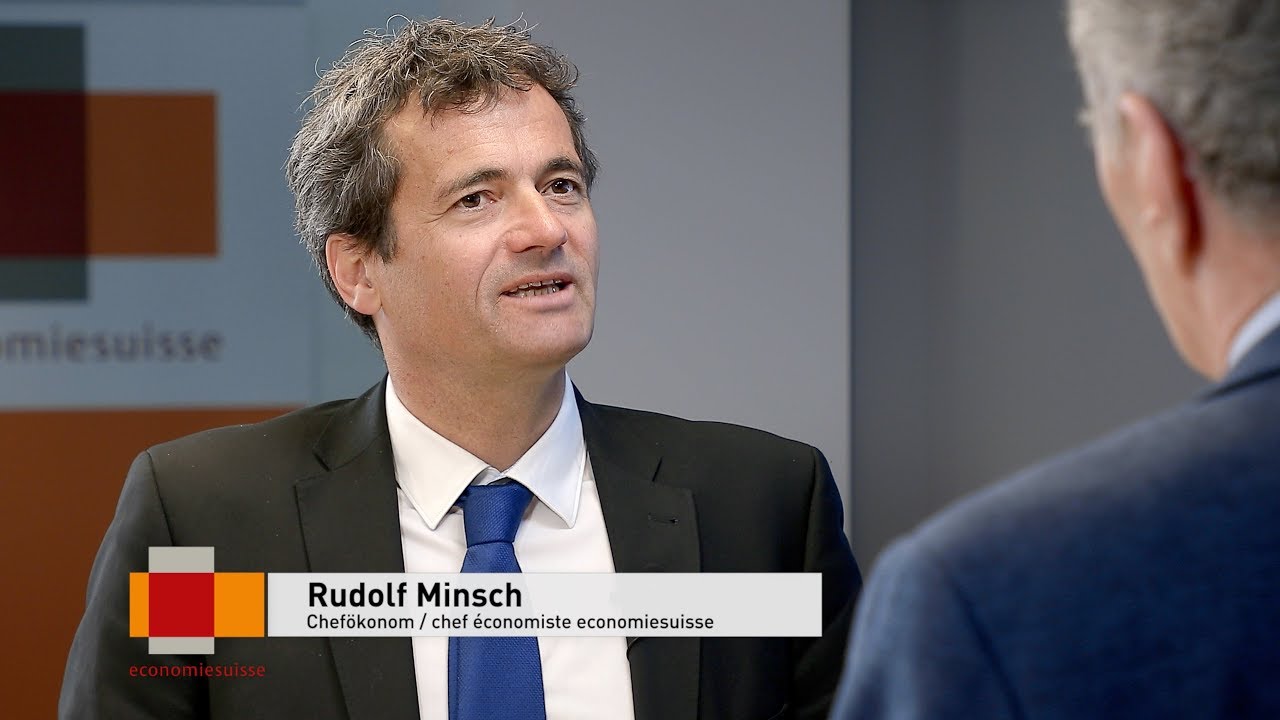
They talk of growth, of models, of abstract prosperity. But behind the reassuring charts and expert formulas, another reality is dawning: that of a country under pressure, where housing, infrastructure, and wages tell a very different story. When Economiesuisse transforms the economy into political discourse, it’s time to dismantle the arguments, one by one.
(Source: L'Agefi, 16 April 2026)
Behind the technocratic veneer, Rudolf Minsch's discourse is less about economic analysis and more about a carefully crafted political narrative. Using abstract models, flattering averages, and simplified causality, he champions a vision where quantitative growth justifies everything – including the gradual erosion of Swiss equilibria. A point-by-point analysis.
«Foreign workers do not replace local labour»: a theoretical assertion, contradicted by the facts
Minsch states that foreign workers are «complementary».
⮕ Problem This vision is based on an ideal model of the labour market.
Observable reality
- In many sectors (construction, healthcare, services), wage pressure is documented.
- The widespread use of foreign labour increase the supply of labour, which, mechanically, slow the rise in real wages.
- Companies often favour more flexible or less costly profiles.
Even standard economic theory (supply/demand) indicates that a rapid increase in the supply of labour alter the market balance.
2. «GDP per head has been increasing since 2002»: a misleading indicator
Key quote (Agefi):
«The GDP per capita has increased throughout the period since 2002.»
⮕ Yes, but:
- This increase is low compared to total GDP growth.
- It is partly driven by specific sectors (pharma, finance).
- She mask the stagnation of median purchasing power in some regions.
The crucial point recognised in the article itself:
Swiss growth is «mostly driven by population increases».
In other words:
Extensive growth (more inhabitants) ≠ real individual prosperity.
3. Immigration and Housing: Reversal of Causality
Minsch states that the housing crisis is «of our own making» (regulation, slow permits).
⮕ Incomplete argument:
- Switzerland hosted +75,000 people in 2023.
- Every arrival creates an immediate demand for accommodation.
- The offer, structurally rigid, cannot keep up with this pace.
Logical result:
Explosion of rents = demographic pressure + supply constraints.
Ignoring the request is tantamount to denying a fundamental economic law.
4. The «chaos» scenario: fear rhetoric
Minsch evokes:
- « migratory and security chaos »
- End of bilateral talks
- the questioning of Schengen
⮕ Problem:
- These scenarios are based on Hypothetical political scenarios, no economic certainties.
- They are more a matter of Strategic communication That's analysis.
Reminder:
Switzerland has historically known how to renegotiate and adapt its agreements.
Presenting any alternative as «chaos» is a Overdramatisation.
5. Economic Models (Ecoplan): Fragile Projections
Advanced figures:
- -4,9% de PIB (Ecoplan)
- -7.1% (BAK Economics)
- -2500 CHF per year per capita
⮕ But Minsch himself acknowledges:
«It is impossible to know with certainty…»
Major issues:
- Sensitivity assumptions (capital mobility, firm behaviour)
- Results highly dependent on the chosen model
- Significant divergences between studies (e.g. SwissEconomics: -0.9%)
Conclusion:
These figures are not facts, but scenarios.
6. Essential foreign labour? A biased viewpoint
Minsch states:
«Switzerland cannot provide enough workers.»
⮕ Counter-arguments:
- Under-exploited potential
- Perverse effect
An economy dependent on immigration becomes structurally unsound.
7. Productivity: the blind spot
The article acknowledges:
- Swiss productivity slowing down relatively (OECD)
- concentration in a few sectors
Paradox:
Minsch defends a model that promotes population growth
while the real challenge is qualitative productivity.
Risk:
- dilution of the Swiss business model
- reliance on extensive growth
Conclusion — Growth at all costs: a strategic dead end
Rudolf Minsch's speech is based on a simplistic equation:
immigration = growth = prosperity.
But the facts show a more complex reality:
- pressure on infrastructure
- Stagnation of the standard of living
- growing economic dependence
- the destabilisation of social balances
By dint of reasoning in aggregates and models, we forget the essential:
An economy is not made to maximise curves, but to serve a population.
And on this point, the certainties displayed by Economiesuisse appear less like expertise... than like ideological line.
Did this analysis make you think? Like this to help us reach a wider audience.